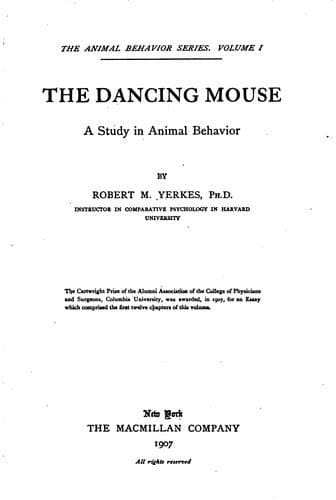
The Dancing Mouse: A Study in Animal BehaviorYerkes, Robert Mearns
Science
The Dancing Mouse: A Study in Animal Behavior
Yerkes, Robert Mearns
Animal behavior; Dancing mice
The simplest possible test of the intelligence of the dancer which I could
devise was the following. Beside the cage in which the mice were kept I
placed a wooden box 26 cm. long, 23 cm. wide, and 12 cm. deep. Neither
this box nor the cage was covered, for the animals did not attempt to
climb out. As a way of passing from one of these boxes to the other I
arranged a ladder made of wire fly-screen netting. This ladder was about 8
cm. broad and it extended from the middle of one side of the wooden box
upward at an angle of about 30° to the edge of the box and then descended
at the same angle into the cage.
A dancer when taken from the nest-box and placed in the wooden box could
return to its cage and thus find warmth, food, and company by climbing the
ladder. It was my aim to determine, by means of this apparatus, whether
the dancers can learn such a simple way of escape and whether they learn
by watching one another. As it turned out, a third value belonged to the
tests, in that they were used also to test the influence of putting the
mice through the act.
In the first experiment three dancers, Nos. 1000, 2, and 6, were together
placed in the wooden box. At the end of 15 minutes not one of them had
succeeded in returning to the cage. They were then driven to the bottom of
the ladder and started upward by the experimenter; with this assistance
all escaped to the nest-box. At the expiration of 5 minutes they were
again placed in the wooden box, whence the chilly temperature (about 60°
F.) and the lack of food made them eager to return to their cage. No
attempt to climb up the ladder was made by any of them within 15 minutes,
so the experimenter directed them to the ladder and started them upward as
in the first test. This completed the experiment for the day. The
following day two tests were given in the same way. In the second of these
tests, that is, on its fourth trial, No. 1000 climbed over of his own
initiative in 5 minutes. The others had to be assisted as formerly. On the
third day No. 1000 found his way back to the nest-box quickly and fairly
directly, but neither No. 2 or No. 6 climbed of its own initiative in the
first test. When their movements were restricted to the region of the box
about the base of the ladder, both of them returned to the cage quickly.
And on the second test of the third day all the mice climbed the ladder
directly.
In Table 35 I have given the time required for escape in the case of 40
tests which were given to these 3 individuals at the rate of 2 tests per
day.
Public-domain text, read in full here on John Shaqi.
Reviews
Reviews
No reviews yet
Be the first to share your thoughts on this work.
Elsewhere in the archive
Join the Discussion
Join the discussion
Sign in to leave a comment or review.
Sign InorCreate an account