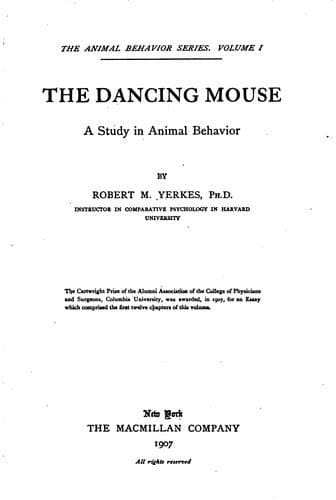
The Dancing Mouse: A Study in Animal BehaviorYerkes, Robert Mearns
Science
The Dancing Mouse: A Study in Animal Behavior
Yerkes, Robert Mearns
Animal behavior; Dancing mice
25 26 3" 8" 44" 18"
26 19" 1" 176" 98" 58"
27 27 150" 79" 269" 166"
28 26" 3" 31" 20" 93"
29 28 214" 18" 267" 166"
30 40" 3" 4" 16" 91"
31 29 130" 45" 250" 142"
32 12" 3" 25" 13" 77"
33 Dec. 2 61" 35" 44" 47"
34 50" 5" 24" 26" 36"
35 3 66" 18" 2" 29"
36 8" 5" 10" 8" 19"
37 4 9" 4" 3" 5"
38 10" 5" 6" 7" 6"
39 5 5" 3" 5" 4"
40 10" 4" 3" 6" 5"
One of the most interesting and important features of the behavior of the
dancer in the ladder experiment was a halt at a certain point on the
ladder. It occurred just at the edge of the wooden box at the point where
the ladder took a horizontal position, and led over into the cage. Every
individual from the first test to the last made this halt. Although from
the point of view of the experimenter the act was valueless, it may have
originated as an attempt to find a way to escape from the uncomfortable
position in which the animal found itself on reaching the top of the
ladder. Its persistence after a way of escape had been found is an
indication of the nature of habit. Day after day the halt became shorter
until finally it was little more than a pause and a turn of the head
toward one side of the ladder. I think we may say that in this act we have
evidence of the persistence of a particular resolution of physiological
states which is neither advantageous nor disadvantageous to the organism.
Had the act resulted in any gain, it would have become more marked and
elaborate; had it resulted in injury or discomfort, it would have
disappeared entirely. I have observed the same kind of behavior in the
frog and in other animals. What the animal begins to do it persists in
unless the act is positively harmful or conflicts with some beneficial
activity. The only explanation of certain features of behavior is to be
found in the conditions of their original occurrence. They persist by
sheer force of conservatism. They have value only in the light of the
circumstances under which they first appeared. Although this is merely a
fact of habit formation, it suggests that many of the problems which have
puzzled students of behavior for ages may be solved by a study of the
history of activity.
Public-domain text, read in full here on John Shaqi.
Reviews
Reviews
No reviews yet
Be the first to share your thoughts on this work.
Elsewhere in the archive
Join the Discussion
Join the discussion
Sign in to leave a comment or review.
Sign InorCreate an account