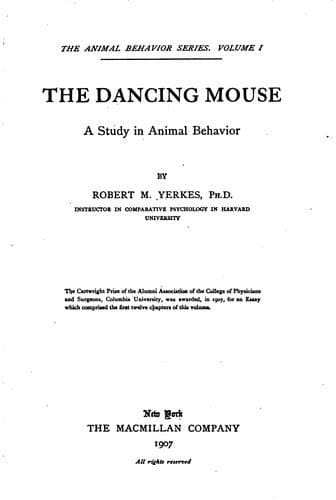
The Dancing Mouse: A Study in Animal BehaviorYerkes, Robert Mearns
Science
The Dancing Mouse: A Study in Animal Behavior
Yerkes, Robert Mearns
Animal behavior; Dancing mice
In the pages which follow, individual, age, and sex peculiarities are
discussed in turn. Within each of these three groups of differences I have
arranged in order what Royce has appropriately named the facts of
discriminating sensitiveness, docility, and initiative. Individuals of the
same age and sex no less than those which differ in sex or age exhibit
important differences in ability to discriminate among sense impressions
("discriminative sensitiveness"), in ability to profit by experience
("docility"), and in ability to try new kinds of behavior ("initiative").
Individual differences in sensitiveness to visual, auditory, tactual, and
olfactory stimuli have been revealed by many of my experiments. The
brightness discrimination tests conclusively proved that a degree of
difference in illumination which is easily detectable by one dancer may be
beyond the discriminating sensitiveness of another. Both the tests with
gray papers and those with the Weber's law apparatus furnished striking
evidence of individual differences in the kind of visual sensitiveness
which throughout this book has been called brightness vision. I suspect
that certain of the differences which were observed should be referred to
the experience of the individuals rather than to the capacity of the
visual organs, for training improves visual discrimination to a much
greater extent than would ordinarily be thought possible. To the truth of
this statement the results of the Weber's law experiments with No. 51 bear
witness. Likewise in color discrimination there are individual
differences, examples of which may be discovered by the examination of the
results given in Chapters IX and X.
No differences in auditory sensitiveness appeared in my adult dancers, for
in none of them was there definite response to sounds, but among the young
individuals differences were prominent. I may call attention to the data
on this subject which Table 5, p. 89, contains. The mice in four out of
twelve litters gave no indications of hearing any sounds that I was able
to produce; the remaining individuals responded with varying degrees of
sensitiveness. I made no attempt to measure this sensitiveness, but it
obviously differed from mouse to mouse. I feel justified, therefore, in
stating that the young dancers exhibit extreme individual difference in
sensitiveness to sounds.
Public-domain text, read in full here on John Shaqi.
Reviews
Reviews
No reviews yet
Be the first to share your thoughts on this work.
Elsewhere in the archive
Join the Discussion
Join the discussion
Sign in to leave a comment or review.
Sign InorCreate an account