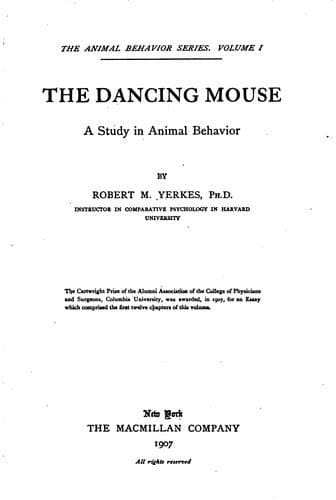
The Dancing Mouse: A Study in Animal BehaviorYerkes, Robert Mearns
Science
The Dancing Mouse: A Study in Animal Behavior
Yerkes, Robert Mearns
Animal behavior; Dancing mice
My observations of differences in sensitiveness to other forms of
stimulation were made in connection with training tests, and although they
are not quantitative, I venture to call attention to them. Indeed, I am
led by the results of my study of various aspects of the dancer's behavior
to conclude that the race exhibits individual differences in
discriminating sensitiveness to a far greater extent than do most mammals,
not excepting man. The importance of this fact (for I am confident that
any one who carefully examines the detailed results of the various
experiments which are described in this book will agree that it is an
established fact) cannot be overlooked. It alters our interpretation of
the results of training, memory, heredity, and discrimination experiments,
and it leads us to suspect that the dancing race is exceedingly unstable.
I do not venture to make comparison of my own observations of the dancer's
sense equipment with those of Cyon, Rawitz, Zoth, and Kishi, for the
differences are too great in many instances to be thought of as other than
species or variety peculiarities. It has seemed fairer to compare only
individuals of the same breed, or, as I have done and shall continue to do
throughout this chapter, of two lines of descent.
With respect to docility individual differences are prominent. We need
only turn to the various tables of results to discover that in
modifiability of behavior, in memory, in re-learning, not to mention other
aspects of docility, dancers of the same sex and age differed strikingly.
Let me by way of illustration cite a few cases of difference in docility.
Number 1000 learned to discriminate white from black more quickly and
retained his habit longer than any other dancer with which I have
experimented. I should characterize him as an exceptionally docile
individual. Table 44 offers several examples. Numbers 403 and 407, though
they were born in the same litter and were alike in appearance and in
conditions of life, acquired the white-black habit with a difference in
rapidity which is expressed by the indices of modifiability 50 and 100. In
other words, it took No. 407 twice as long to acquire this habit as it
took No. 403. Similarly the ladder-climbing tests revealed important
individual differences in ability to profit by experience. In the tables
of labyrinth tests (38, 39, 40) individual differences are too numerous to
mention. It required forty-nine tests to establish in No. 50 a labyrinth-C
habit which was approximately equal in degree of perfection to that which
resulted from twenty-two tests in the case of No. 52. The figures in this
and other instances do not exaggerate the facts, for repeatedly I have
tested individuals of the same litter, the same sex, and, so far as I
could judge, of the same stage of development, and obtained results which
differ as markedly as do those just cited. If space limits permitted, I
could present scores of similar differences in docility which the problem,
Public-domain text, read in full here on John Shaqi.
Reviews
Reviews
No reviews yet
Be the first to share your thoughts on this work.
Elsewhere in the archive
Join the Discussion
Join the discussion
Sign in to leave a comment or review.
Sign InorCreate an account