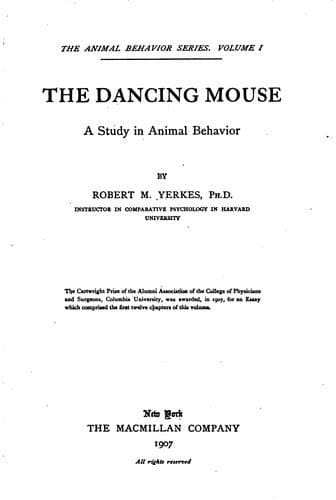
The Dancing Mouse: A Study in Animal BehaviorYerkes, Robert Mearns
Science
The Dancing Mouse: A Study in Animal Behavior
Yerkes, Robert Mearns
Animal behavior; Dancing mice
labyrinth, and discrimination methods have revealed.
In examining the detailed individual results of the various tables for
differences of this sort, it is important to bear in mind that sex, age,
and descent should be taken into account, for with each of them, as will
be shown clearly later in this chapter, sensitiveness, docility, and
initiative vary. I have therefore based my statements concerning
individual differences in docility upon the results of comparison of mice
of the same litter, sex, and age. It is safe to say that human beings
similarly selected for comparison do not exhibit greater differences in
ability to profit by experience than did these dancing mice.
The facts concerning individual differences in initiative which I have
discovered are not less definite than those of the preceding paragraphs.
From the beginning of my study of the dancer I observed that what one
individual would readily learn of his own initiative another never
learned. For example, in the ladder-climbing experiment No. 1000
distinguished himself for his initiative, whereas Nos. 4 and 5 never
acquired the habit of escaping from confinement by using the ladder. I
noticed, in this test of the animal's ability to learn, that while one
individual would be scurrying about trying all ways of escape,
investigating its surroundings, looking, sniffing, and dancing by turns,
another would devote all its time to whirling, circling, or washing
itself. One in the course of its activity would happen upon the way of
escape, the other by reason of the limited scope of its activity, not the
lack of it, would fail hour after hour to discover even the simplest way
of getting back to its nest, to food, and to its companions. Hundreds of
times during the past three years I have noticed important individual
differences in initiative in connection with the discrimination
experiments. The swinging wire doors which one dancer learned to push open
before he had been in the box five minutes, another might not become
familiar with through his own initiative for hours or days. In fact, it
was not seldom that I had to teach an individual to pass from one
compartment to the other by gently pushing him against the door until it
opened sufficiently to allow him to squeeze through. Occasionally a mouse
learned to pull the doors open so that he could pass through the openings
in either direction with facility. This was a form of individual
initiative which I had not anticipated and did not especially desire, so I
did not encourage its development, but, nevertheless, at least one fourth
of the mice which I experimented with in the discrimination box learned
the trick. The other three fourths, although they were used in the box day
after day sometimes for weeks, never discovered that they might return to
the nest-box by pulling the swing-door through which they had just passed
as well as by entering one of the electric-boxes.
Public-domain text, read in full here on John Shaqi.
Reviews
Reviews
No reviews yet
Be the first to share your thoughts on this work.
Elsewhere in the archive
Join the Discussion
Join the discussion
Sign in to leave a comment or review.
Sign InorCreate an account