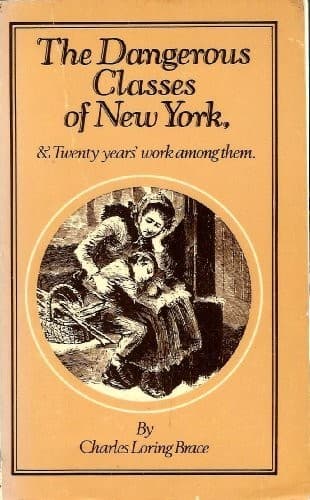
The Dangerous Classes of New York, and Twenty Years' Work Among Them — John Shaqi
The Dangerous Classes of New York, and Twenty Years' Work Among ThemBrace, Charles Loring
History
The Dangerous Classes of New York, and Twenty Years' Work Among Them
Brace, Charles Loring
Child welfare -- New York (State) -- New York; New York (N.Y.) -- Social conditions; Poor -- New York (State) -- New York
It was provided also, that in future no one should "take from the
ground" exposed children except in the presence of witnesses, and that
the archbishop should put his signature on the document of guardianship
which was prepared. (Cod. Theod., lib. 5, tit. 7, De Expositis.)
Hitherto, exposed children had generally been taken and reared as
slaves; but in A. D. 529, Justinian decreed that not only the father
lost all legitimate authority over the child if he exposed it, but also
that the child itself preserved its liberty.
This law applied only to the Eastern Empire; in the Western the slavery
of exposed children continued for centuries. (Lecky: Hist. of Europ.
Morals, vol. ii, p. 32.) The Christian churches throughout the early
centuries took especial care of orphans, in parish orphan nurseries, or
_orphanotrophioe._
The first asylums for deserted and foundling children which are recorded
in the Christian era are one in Treves in the sixth century, one at
Angiers in the seventh, and a more famous one in Milan, A. D. 787.
Societies for the protection of children were also formed in Milan in
the middle of the twelfth century.
At the end of that century a monk of Montpelier, Brother GUY, formed
what may be called the first "Children's Aid Society," for the
protection, shelter, and education of destitute children, a fraternity
which subsequently spread over Europe.
One great cause of the final extreme corruption and extinction of
ancient pagan society was the existence of large classes of unfortunate
beings, whom no social moral movement of renovation ever reached--the
slaves, the gladiators, the barbarian strangers, and the outcast
children.
To all these deep strata of misery and crime Christianity gradually
penetrated, and brought life and light, and finally an almost entire
metamorphosis. As criminal and unfortunate classes, they have--with the
exception only of the children--ceased to exist under modern
civilization. We have no longer at the basis of modern society the
dangers of a multitude of ignorant slaves, or of disaffected barbarous
foreigners, or of a profession of gladiators--brutal, brutalizing; but
we do still have masses of unfortunate youth, whose condition, though
immensely improved, and lightened by the influences of Christianity, is
still one of the most threatening and painful phenomena of modern
society in nearly all civilized countries.
Still, unlike the experience of Paganism under the Roman Empire and
before it, rays of light, of intelligence, and of moral and spiritual
influence penetrate to the depths of these masses. The spirit of Christ
is slowly and irresistibly permeating even this lowest class of
miserable, unfortunate, or criminal beings; inspiring those who
perseveringly labor for them, drawing from wealth its dole and from
intelligence its service of love, educating the fortunate in the habit
of duty to the unfortunate, giving a dignity to the most degraded, and
offering hope to the despairing.
Public-domain text, read in full here on John Shaqi.
Reviews
Reviews
No reviews yet
Be the first to share your thoughts on this work.
Join the Discussion
Join the discussion
Sign in to leave a comment or review.
Sign InorCreate an account