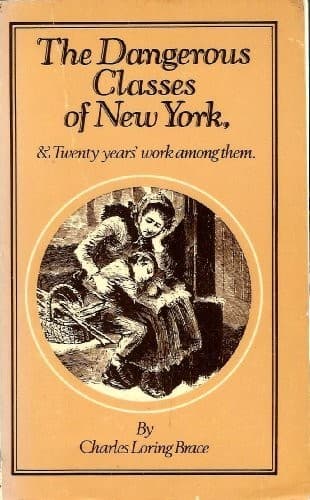
The Dangerous Classes of New York, and Twenty Years' Work Among ThemBrace, Charles Loring
History
The Dangerous Classes of New York, and Twenty Years' Work Among Them
Brace, Charles Loring
Child welfare -- New York (State) -- New York; New York (N.Y.) -- Social conditions; Poor -- New York (State) -- New York
Probably the first society or asylum in history for poor children was
the foundation established by the Emperor Trajan (about A. D. 110) for
destitute and abandoned children. The property thus established in
perpetuity, with real estate and money at interest (at five per cent.),
was equivalent in value to $920,000, and supported some five thousand
children of both sexes. Singularly enough, there seems to have been only
one illegitimate child to one hundred and fifty legitimate in these
institutions.
The Antonines, as might be expected, did not neglect this charity; but
both Antoninus Pius and Marcus Aurelius founded associations for
destitute girls. Alexander Severus established one also for poor
children. These form the only organized efforts made for this object,
during many centuries, by the most civilized and refined state of
antiquity.
The number, however, of these wretched creatures, increased beyond all
cure from scattered exceptional efforts like these. Everywhere the poor
got rid of their children by exposure, or sold them as slaves. The rich,
if indifferent to their offspring, or unwilling to take the trouble of
rearing them, sent them out to the public square, where pimps, beggars,
witches, and slave-dealers gleaned their horrible harvest. At length,
under the influence of Christianity, legislation began to take
cognizance of the practice.
The Emperor Constantine, the Emperor Valentian, Valens, and Gratian,
sixty years later, continued this humane legislation.
They ordered, under strict penalties, that every one should nourish his
own children, and forbade exposition; declaring also that no one had the
right to reclaim the children he had abandoned; the motive to this law
being the desire to make it for the interest of those "taking up"
exposed children to keep them, even if necessary, as slaves, against any
outside claims.
Unfortunately, at that period, slavery was held a less evil than the
ordinary fate to which the poor left their children.
The punishment of death was also decreed against Infanticide.
It is an interesting fact that a portion, and probably the whole, of our
ancestral tribes looked with the greatest horror on abortion and
infanticide. The laws of the Visigoths punished these offenses with
death or blindness. Their influence, of course, should always be
considered, as well as that of Christianity, in estimating the modern
position of woman and the outcast child, as compared with their status
under Greek and Roman civilization.
At a later period (412 A. D.) the imperial legislation again endeavored
to prevent the reclaiming of exposed children from compassionate persons
who had taken them. "Were they right to say that those children belonged
to them when they had despised them even to the point of abandoning them
to death?"
Public-domain text, read in full here on John Shaqi.
Reviews
Reviews
No reviews yet
Be the first to share your thoughts on this work.
Join the Discussion
Join the discussion
Sign in to leave a comment or review.
Sign InorCreate an account