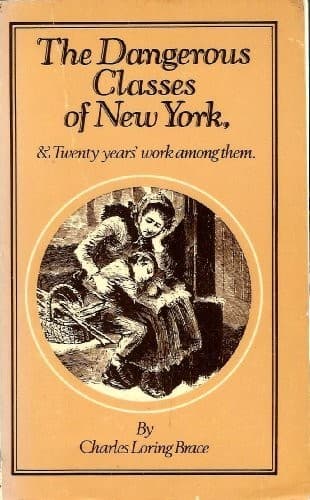
The Dangerous Classes of New York, and Twenty Years' Work Among ThemBrace, Charles Loring
History
The Dangerous Classes of New York, and Twenty Years' Work Among Them
Brace, Charles Loring
Child welfare -- New York (State) -- New York; New York (N.Y.) -- Social conditions; Poor -- New York (State) -- New York
Of the number of the distinctly homeless and vagrant youth in New York,
it is difficult to speak with precision. We should be inclined to
estimate it, after long observation, as fluctuating each year between
20,000 and 30,000. [The homeless children who come each year under the
charitable efforts afterwards to be described amount to some 12,000.]
But to these, as they mature, must be added, in the composition of the
dangerous classes, all those who are professionally criminal, and who
have homes and lodging-places. And again to these, portions of that vast
and ignorant [It should be remembered that there are in this city over
60,000 persons above ten years of age who cannot write their names.]
multitude, who, in prosperous times, just keep their heads above water,
who are pressed down by poverty or misfortune, and who look with envy
and greed at the signs of wealth and luxury all around them, while they
themselves have nothing but hardship, penury, and unceasing drudgery.
CHAPTER III.
THE CAUSES OF CRIME.
The great practical division of causes of crime may be made into
preventible and non-preventible. Among the preventible, or those which
can be in good part removed, may be placed ignorance, intemperance,
over-crowding of population, want of work, idleness, vagrancy, the
weakness of the marriage-tie, and bad legislation.
Among those which cannot be entirely removed are inheritance, the
effects of emigration, orphanage, accident or misfortune, the strength
of the sexual and other passions, and a natural weakness of moral or
mental powers.
IGNORANCE.
There needs hardly a word to be said in this country on the intimate
connection between ignorance and crime.
The precise statistical relation between them in the State of New York
would seem to be this: about thirty-one per cent. of the adult criminals
cannot read or write, while of the adult population at large about six
(6.08) per cent. are illiterate; or nearly one-third of the crime is
committed by six-hundredths of the population. In the city prisons for
1870, out of 49,423 criminals, 18,442 could not write and could barely
read, or more than thirty-three per cent.
[Illustration: THE FORTUNES OF A STREET WAIF. (Second Stage.)]
In the Reformatories of the country, according to the statement of Dr.
Bittinger before the National Congress on prison-discipline at
Cincinnati, out of the average number of the inmates for 1868, of 7,963
twenty-seven per cent. were wholly illiterate.
Very great criminality is, of course, possible with high education; but
in the immense majority of cases a very small degree of mental training
or intellectual tastes is a preventive of idleness and consequent crime
and of extreme poverty. The difference between knowing how to read and
not knowing will often be the line between utter poverty and a capacity
for various occupations.
Public-domain text, read in full here on John Shaqi.
Reviews
Reviews
No reviews yet
Be the first to share your thoughts on this work.
Join the Discussion
Join the discussion
Sign in to leave a comment or review.
Sign InorCreate an account