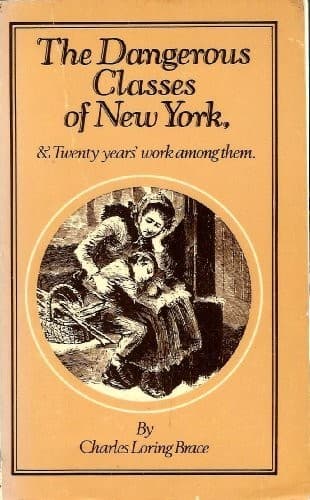
The Dangerous Classes of New York, and Twenty Years' Work Among ThemBrace, Charles Loring
History
The Dangerous Classes of New York, and Twenty Years' Work Among Them
Brace, Charles Loring
Child welfare -- New York (State) -- New York; New York (N.Y.) -- Social conditions; Poor -- New York (State) -- New York
Among the inmates of the city prisons a large percentage are without a
trade, and no doubt this idle condition is largely due to their
ignorance and is one of the great stimulants to their criminal course.
Who can say how much the knowledge of Geography alone may stimulate a
child or a youth to emigrate, and thus leave his immediate temptations
and escape pressing poverty?
ORPHANAGE.
Out of 452 criminal children received into the House of Refuge in New
York during 1870, only 187 had both parents living, so that nearly sixty
per cent. had lost one or both of their parents, or were otherwise
separated from them.
According to Dr. Bittinger, [Transactions of the National Congress, p.
279.] of the 7,963 inmates of the reformatories in the United States in
1870, fifty-five per cent. were orphans or half orphans.
The following figures strikingly show the extent to which orphanage and
inheritance influence the moral condition of children.
Mettrai, the celebrated French reformatory, has received since its
foundation 3,580 youthful inmates. Of these, there are 707 whose parents
are convicts; 308 whose parents live in concubinage; 534 "natural"
children; 221 foundlings; 504 children of a second marriage; and 1,542
without either father or mother. [Une visite a Mettrai. Paris, 1868.]
An intelligent French writer, M. de Marsangy, [Moralisation de l'enfance
coupable, p. 18.] in writing of the causes of juvenile crime in France,
says that "a fifth of those who have been the objects of judicial
pursuit are composed of orphans; the half have no father, a quarter no
mother, and as for those who have a family, nearly all are dragged by it
into evil."
EMIGRATION.
There is no question that the breaking of the ties with one's country
has a bad moral effect, especially on a laboring class. The Emigrant is
released from the social inspection and judgment to which he has been
subjected at home, and the tie of church and priesthood is weakened. If
a Roman Catholic, he is often a worse Catholic, without being a better
Protestant. If a Protestant, he often becomes indifferent. Moral ties
are loosened with the religious. The intervening process which occurs
here, between his abandoning the old state of things and fitting himself
to the new, is not favorable to morals or character.
The consequence is, that an immense proportion of our ignorant and
criminal class are foreign-born; and of the dangerous classes here, a
very large part, though native-born, are of foreign parentage. Thus, out
of the whole number of foreigners in New York State, in 1860, 16.69 per
cent. could not read or write; while of the native-born only 1.83 per
cent. were illiterate.
Public-domain text, read in full here on John Shaqi.
Reviews
Reviews
No reviews yet
Be the first to share your thoughts on this work.
Join the Discussion
Join the discussion
Sign in to leave a comment or review.
Sign InorCreate an account