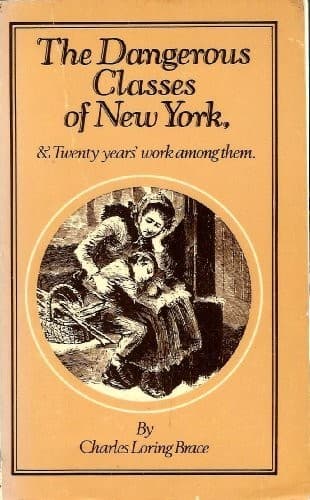
The Dangerous Classes of New York, and Twenty Years' Work Among ThemBrace, Charles Loring
History
The Dangerous Classes of New York, and Twenty Years' Work Among Them
Brace, Charles Loring
Child welfare -- New York (State) -- New York; New York (N.Y.) -- Social conditions; Poor -- New York (State) -- New York
Food, indeed, is given every day to those most in need; but, being
connected thus with a School, it produces none of the ill effects of
alms. The subject of clothes-giving to these children is, however, a
very difficult one. The best plan is found to be to give the garments as
rewards for good conduct, punctuality, and industry, the amount being
graded by careful "marks"; yet the humane teacher will frequently
discover an unfortunate child without shoes in the winter snow, or
scantily clad, who has not yet attained the proper number of marks, and
she will very privately perhaps relieve the want: knowing, as the
teacher does, every poor family whose children attend the School, she is
not often deceived, and her gifts are worthily bestowed.
The daily influence of the School-training in industry and intelligence
discourages the habit of begging. The child soon becomes ashamed of it,
and when she finally leaves school, she has a pride in supporting
herself.
Gifts of garments, shoes, and the like, to induce children to attend,
are not found wise; though now and then a family will be discovered so
absolutely naked and destitute, that some proper clothing is a necessary
condition to their even entering the School.
Some of the teachers very wisely induce the parents to deposit their
little savings with them, and perhaps pay them interest to encourage
saving. Others, by the aid of friends, have bought coal at wholesale
prices, and retailed it without profit, to the parents of the children.
The principle throughout all the operations of the Children's Aid
Society, is only to give assistance where it bears directly on
character, to discourage pauperism, to cherish independence, to place
the poorest of the city, the homeless children, as we have so often
said, not in Alms-houses or Asylums, but on farms, where they support
themselves and add to the wealth of the nation; to "take, rather than
give;" or to give education and work rather than alms; to place all
their thousands of little subjects under such influences and such
training that they will never need either private or public charity.
CHAPTER XXXIII.
HOW SHALL CRIMINAL CHILDREN BE TREATED?
REFORMATORIES.
Public-domain text, read in full here on John Shaqi.
Reviews
Reviews
No reviews yet
Be the first to share your thoughts on this work.
Elsewhere in the archive
Join the Discussion
Join the discussion
Sign in to leave a comment or review.
Sign InorCreate an account