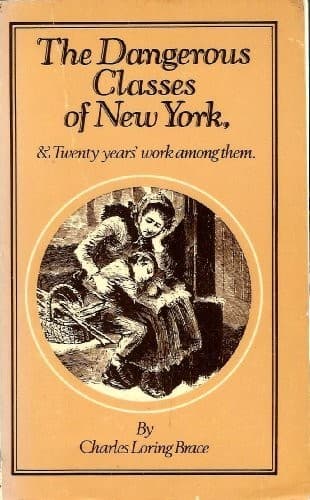
The Dangerous Classes of New York, and Twenty Years' Work Among ThemBrace, Charles Loring
History
The Dangerous Classes of New York, and Twenty Years' Work Among Them
Brace, Charles Loring
Child welfare -- New York (State) -- New York; New York (N.Y.) -- Social conditions; Poor -- New York (State) -- New York
A child, whether good or bad, is, above all things, an individual
requiring individual treatment and care. Let any of our readers, having
a little fellow given to mischief, who had at length broken his
neighbor's windows, or with a propensity to stealing, or with a quick
temper which continually brings him into unpleasant scrapes, imagine him
suddenly put into an "Institution" for reform, henceforth designated as
"D" of "Class 43," or as "No. 193," roused up to prayers in the morning
with eight hundred others, put to bed at the stroke of the bell, knowing
nothing of his teacher or pastor, except as one of a class of a hundred,
his own little wants, weaknesses, foibles and temptations utterly
unfamiliar to any one, his only friends certain lads who had been in the
place longer, and, perhaps, had known much more of criminal life than he
himself, treated thus altogether as a little machine, or as one of a
regiment.
What could he expect in the way of reform in such a case? He might,
indeed, hope that the lad would feel the penalty and disgrace of being
thus imprisoned, and that the strict discipline would control careless
habits, but he would soon see that the chance of a reform of character
was extremely slight.
There was evidently no personal influence on the child. Whatever bad
habits or traits he had, were likely to be uneradicated. The strongest
agencies upon him were those of his companions; and what boys, even of
the moral classes, teach one another when they are together in masses,
need not be told. Were he to be there a length of time, the most
powerful forces that mould and form boys in the world outside, would be
absent.
The affection of family, the confidence of respected friends, the hope
of making a name, and the desire of money and position--these impulses
must be banished from the Asylum or Reformatory. The lad's only hope is
to escape certain penalties, or win certain marks, and get out of the
place. Now and then, indeed, a chaplain of rare spiritual gifts may
succeed in wielding a personal influence, in such an Institution, over
individual children; but this must, of necessity, be unfrequent, on
account of the great numbers under his charge.
If the subject of a Reformatory be a poor boy or girl, the kind of work
usually chosen is not the one best suited to a child of this class, or
which he will be apt to take up afterwards. It is generally some plain
and easy trade-work, like shoe-pegging, or chair-bottoming, or
pocket-book manufacture. The lad is kept for years at this drudgery, and
when he leaves the place, has no capital laid up of a skilled trade. He
finds such employments crowded, and he seldom enters them again.
Moreover, if he has been a vagrant (as in nine cases out of ten is
probable), or a little sharper and thief of the city, or a boy unwilling
to labor, and unfitted for steady industry, these years at a table in a
factory do not necessarily give him a taste for work; they often only
disgust him.
Public-domain text, read in full here on John Shaqi.
Reviews
Reviews
No reviews yet
Be the first to share your thoughts on this work.
Elsewhere in the archive
Join the Discussion
Join the discussion
Sign in to leave a comment or review.
Sign InorCreate an account