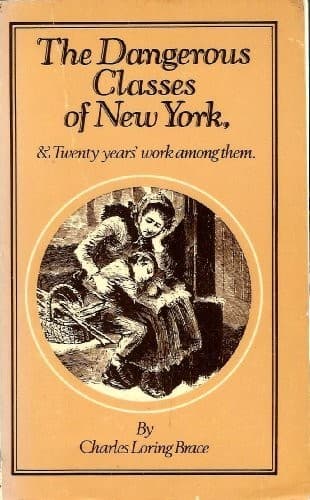
The Dangerous Classes of New York, and Twenty Years' Work Among Them — John Shaqi
The Dangerous Classes of New York, and Twenty Years' Work Among ThemBrace, Charles Loring
History
The Dangerous Classes of New York, and Twenty Years' Work Among Them
Brace, Charles Loring
Child welfare -- New York (State) -- New York; New York (N.Y.) -- Social conditions; Poor -- New York (State) -- New York
There is nearly always a demand for his work; the lad feels himself a
member of a craft and supported by the consciousness of this membership;
the means of the "Unions" often sustain him when out of employment; his
associates are more honest and respectable than those of boys depending
on chance-labor, and so he is preserved from falling into crime.
Of course, if such a lad would walk forth to the nearest country
village, he would find plenty of healthy and remunerative employment in
the ground, as gardener or farmer. And to a country-lad, the farm offers
a better chance than a trade. But many city boys and young men will not
consent to leave the excitements of the city, so that the want of a
mechanical occupation does expose them to many temptations.
The persons most responsible for this state of things are the members of
such "Unions" as refuse to employ boys, or to encourage the training of
apprentices. It is well-known that in many trades of New York, hardly
any young laborers or apprentices are being trained. The result of this
selfish policy will be to reduce the amount of skilled labor in this
city, and thus compel the importation of foreign labor, and to increase
juvenile crime and the burdens on the poor.
Another cause of this increasing separation from trades among the young
is, no doubt, the increasing aversion of American children, whether poor
or rich, to learn anything thoroughly; the boys of the street, like
those of our merchants, preferring to make fortunes by lucky and sudden
"turns," rather than by patient and steady industry.
Our hope in this matter is in the steady demand for juvenile labor in
the country districts, and the substantial rewards which await industry
there.
CHAPTER IV.
THE CAUSES OF CRIME.
WEAKNESS OF THE MARRIAGE-TIE.
Public-domain text, read in full here on John Shaqi.
Reviews
Reviews
No reviews yet
Be the first to share your thoughts on this work.
Join the Discussion
Join the discussion
Sign in to leave a comment or review.
Sign InorCreate an account