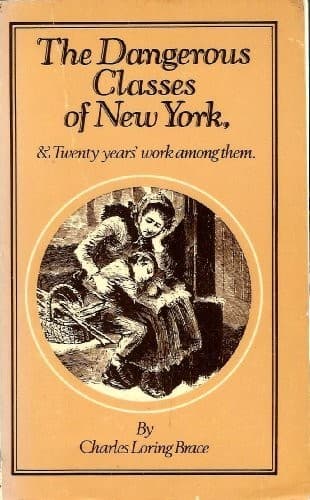
The Dangerous Classes of New York, and Twenty Years' Work Among Them — John Shaqi
The Dangerous Classes of New York, and Twenty Years' Work Among ThemBrace, Charles Loring
History
The Dangerous Classes of New York, and Twenty Years' Work Among Them
Brace, Charles Loring
Child welfare -- New York (State) -- New York; New York (N.Y.) -- Social conditions; Poor -- New York (State) -- New York
It is extraordinary, among the lowest classes, in how large a number of
cases a second marriage, or the breaking of marriage, is the immediate
cause of crime or vagrancy among the children. When questioning a
homeless boy or street-wandering girl as to the former home, it is
extremely common to hear "I couldn't get on with my step-mother," or "My
step-father treated me badly," or "My father left, and we just took care
of ourselves." These apparently exceptional events are so common in
these classes as to fairly constitute them an important cause of
juvenile crime. When one remembers the number of happy second marriages
within one's acquaintance, and how many children have never felt the
difference between their step-mother and their own mother, and what love
and patience and self-sacrifice are shown by parents to their
step-children, we may be surprised at the contrast in another class of
the community. But the virtues of the poor spring very much from their
affections and instincts; they have comparatively little self-control,
the high lessons of duty and consideration for others are seldom stamped
on them, and Religion does not much influence their more delicate
relations with those associated with them. They might shelter a strange
orphan for years with the greatest kindness; but the bearing and
forbearing with the faults of another person's child year after year,
merely from motives of duty or affection to its parent, belong to a
higher range of Christian virtues, to which they seldom attain. Their
own want of self-control and their tendency to jealousy, and little
understanding of true self-sacrifice, combine to weaken and embitter
these relations with step-children. The children themselves have plenty
of faults, and have doubtless been little governed, so that soon both
parties jar and rub against one another; and as neither have instincts
or affections to fall back upon, mere principle or sense of duty is not
enough to restrain them. What would be simply slights or jars in more
controlled persons, become collisions in this class.
Bitter quarrels spring up between step-son and mother, or step-daughter
and father; the other parent sometimes sides with the child, sometimes
with the father; but the result is similar. The house becomes a kind of
pandemonium, and the girls rush desperately forth to the wild life of
the streets, or the boys gradually prefer the roaming existence of the
little city-Arab to such a quarrelsome home. Thus it happens that
step-children among the poor are so often criminals or outcasts.
Public-domain text, read in full here on John Shaqi.
Reviews
Reviews
No reviews yet
Be the first to share your thoughts on this work.
Join the Discussion
Join the discussion
Sign in to leave a comment or review.
Sign InorCreate an account