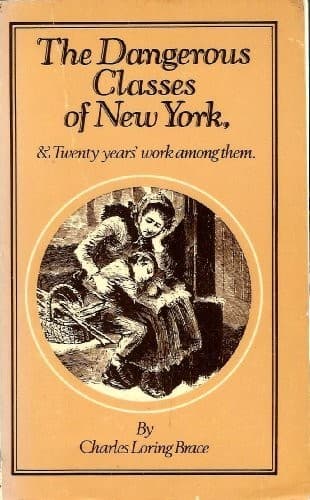
The Dangerous Classes of New York, and Twenty Years' Work Among ThemBrace, Charles Loring
History
The Dangerous Classes of New York, and Twenty Years' Work Among Them
Brace, Charles Loring
Child welfare -- New York (State) -- New York; New York (N.Y.) -- Social conditions; Poor -- New York (State) -- New York
If a female child be born and brought up in a room of one of these
tenement-houses, she loses very early the modesty which is the great
shield of purity. Personal delicacy becomes almost unknown to her.
Living, sleeping, and doing her work in the some apartment with men and
boys of various ages, it is well-nigh impossible for her to retain any
feminine reserve, and she passes almost unconsciously the line of purity
at a very early age.
In these dens of crowded humanity, too, other and more unnatural crimes
are committed among those of the same blood and family.
Here, too, congregate some of the worst of the destitute population of
the city--vagrants, beggars, nondescript thieves, broken-down drunken
vagabonds, who manage as yet to keep out of the station-houses, and the
lowest and most bungling of the "sharpers." Naturally, the boys growing
up in such places become, as by a law of nature, petty thieves,
pickpockets, street-rovers, beggars, and burglars. Their only salvation
is, that these dens become so filthy and haunted with vermin, that the
lads themselves leave them in disgust, preferring the barges on the
breezy docks, or the boxes on the side-walk, from which eventually they
are drawn into the neat and comfortable Boys' Lodging-houses, and there
find themselves imperceptibly changed into honest and decent boys. This
is the story of thousands every year.
The cellar-population alone of this city is a source of incessant
disease and crime.
And with the more respectable class of poor who occupy the better kind
of tenement-houses, the packing of human beings in those great
caravansaries is one of the worst evils of this city. It sows pestilence
and breeds every species of criminal habits.
From the eighteen thousand tenement-houses comes seventy-three per cent.
[In 1865, the deaths in tenement-houses were 14,500 out of 19,813, the
total for the city. The death-rate has, however, been brought down by
sanitary improvements from 76 per cent., in 1866, to about 66 per cent,
in 1871, or a gain of 2,900 lives in these wretched houses.] of the
mortality of our population, and we have little doubt as much as ninety
per cent. of the offenses against property and person.
Over-crowding is the one great misfortune of New York. Without it, we
should be the healthiest large city in the world, [Our annual death-rate
is now 28.79 per 1,000, while some of the clean wards show 15 per 1,000,
or about the rate of the Isle of Wight. The rate of London is about 34,
Liverpool has been as high as 40, but is more healthy now, owing to
sanitary improvements. Our Sixth Ward reaches 48, and "Gotham Court," in
Cherry Street, attains the horrible maximum of 195 per 1,000.] and a
great proportion of the crimes which disgrace our civilization would be
nipped in the bud. While this continues as it does now, there is no
possibility of a thorough sanitary, moral, and religious reform in our
worst wards.
Public-domain text, read in full here on John Shaqi.
Reviews
Reviews
No reviews yet
Be the first to share your thoughts on this work.
Join the Discussion
Join the discussion
Sign in to leave a comment or review.
Sign InorCreate an account