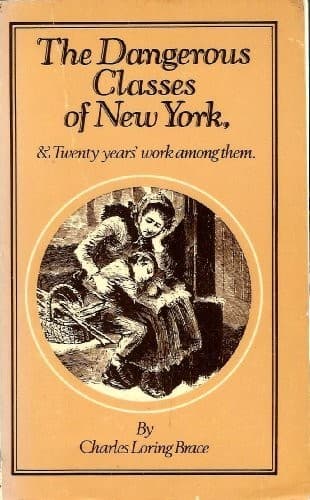
The Dangerous Classes of New York, and Twenty Years' Work Among Them — John Shaqi
The Dangerous Classes of New York, and Twenty Years' Work Among ThemBrace, Charles Loring
History
The Dangerous Classes of New York, and Twenty Years' Work Among Them
Brace, Charles Loring
Child welfare -- New York (State) -- New York; New York (N.Y.) -- Social conditions; Poor -- New York (State) -- New York
The influence of high rents is to force more people into a given space,
in order to economize and divide expense.
The latest trustworthy statistics on this important subject are from the
excellent Reports of the Metropolitan Board of Health for 1866. From
these, it appears that the Eleventh Ward of this city, with a population
of 58,953, has a rate of population of 196,510 to the square mile, or 16
1/10 square yards to each person; the Tenth Ward, with 31,587
population, has a rate of 185,512 to the square mile, or 17 1/10 square
yards to each; the Seventeenth Ward, with 79,563, has the rate of
153,006; the Fourteenth, with 23,382, has a rate of 155,880; the
Thirteenth, with 26,388, has 155,224; and so on with others, though in
less proportion.
The worst districts in London do not at all equal this crowding of
population. Thus, East London shows the rate of 175,816 to the square
mile; the Strand, 141,556; St. Luke's, 151,104; Holborn, 148,705; and
St. Jame's, Westminster, 144,008.
If particular districts of our city be taken, they present an even
greater massing of human beings than the above averages have shown.
Thus, according to the Report of the Council of Hygiene in 1865, the
tenant-house and cellar population of the Fourth Ward numbered 17,611
packed in buildings over a space less than thirty acres, exclusive of
streets, which would make the fearful rate of 290,000 to the square
mile.
In the Seventeenth Ward, the Board of Health reports that in 1868, 4,120
houses contained 95,091 inhabitants, of whom 14,016 were children under
five years. In the same report, the number of tenement-houses for the
whole city is given at 18,582, with an estimate of one-half the whole
population dwelling in them--say 500,000.
We quote an extract from a report of Mr. Dupuy, Visitor of the
Children's Aid Society of the First Ward, describing the condition of a
tenement-house:
"What do you think of the moral atmosphere of the home I am about to
describe below? To such a home two of our boys return nightly.
"In a dark cellar filled with smoke, there sleep, all in one room, with
no kind of partition dividing them, two men with their wives, a girl of
thirteen or fourteen, two men and a large boy of about seventeen years
of age, a mother with two more boys, one about ten years old, and one
large boy of fifteen; another woman with two boys, nine and eleven years
of age--in all, _fourteen persons._
"This room I have often visited, and the number enumerated probably
falls below, rather than above the average that sleep there."
It need not be said that with overcrowding such as this, there is always
disease, and as naturally, crime. The privacy of a home is undoubtedly
one of the most favorable conditions to virtue, especially in a girl.
Public-domain text, read in full here on John Shaqi.
Reviews
Reviews
No reviews yet
Be the first to share your thoughts on this work.
Join the Discussion
Join the discussion
Sign in to leave a comment or review.
Sign InorCreate an account