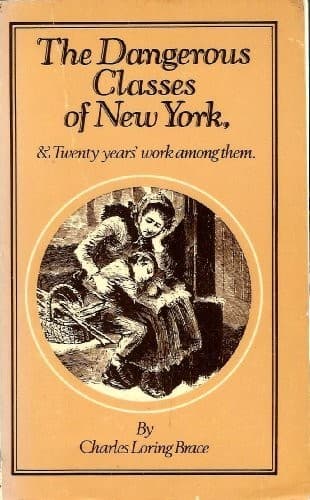
The Dangerous Classes of New York, and Twenty Years' Work Among ThemBrace, Charles Loring
History
The Dangerous Classes of New York, and Twenty Years' Work Among Them
Brace, Charles Loring
Child welfare -- New York (State) -- New York; New York (N.Y.) -- Social conditions; Poor -- New York (State) -- New York
There is, no doubt, some force in the position that the non-licensing of
these houses is in some degree a terror to the community, and that the
cautious and prudent are kept from the offense through fear of possible
consequences in disease and infection. This, however, does not seem to
us an object which legislators can hold before them as compared with the
duties of humanity in curing and preventing disease and pestilence. They
have nothing to do with adding to the natural penalties of sin, or with
punishing sinners. They are concerned only with human law. But they have
the right, and, as it seems to us, the duty, so to legislate as not to
encourage so great an evil as this of prostitution. And licensing, it
seems to us, has that tendency. It certainly has had it in Paris, where
it has been tried to its full extent, and surely no one could claim the
population of that city as a model to any nation, whether in physical or
moral power.
Bad as London is in this matter--not, however, so much through defect of
licensing as through want of a proper street-police--we do not believe
there is so wide-spread a degradation among poor women as in Berlin.
New York, in our judgment, is superior to any great city in its smaller
prostitute class, and the virtue of its laboring poor. Something of
this, of course, is due to our superior economical conditions; something
to the immense energy and large means thrown into our preventive
agencies, but much also to the public opinion prevailing in all classes
in regard to this vice. Our wealthy classes, we believe, and certainly
our middle classes, have a higher sentiment in regard to the purity both
of man and woman than any similar classes in the civilized world. More
persons relatively marry, and marriages are happier. This is equally
true of the upper laboring classes. If it is not true of the lowest
poor, this results from two great local evils--Overcrowding, and the bad
influences of Emigration. Still, even with these, the poor of New York
compare favorably in virtue with those of Paris, Berlin, or Vienna. Now,
how large a part of the public opinion which thus preserves both ends of
society from vice may be due to the fact that we have not recognized the
greatest offense against purity by any permissive legislation? The
business is still regarded, in law, as outside of good morals and not
even to be tacitly allowed by license.
CHAPTER XII.
THE BEST PREVENTIVE OF VICE AMONG CHILDREN.
INDUSTRIAL SCHOOLS.
As a simple, practical measure to save from vice the girls of the honest
poor, nothing has ever been equal to the Industrial School.
Along with our effort for homeless boys, I early attempted to found a
comprehensive organization of Schools for the needy and ragged little
girls of the city.
Public-domain text, read in full here on John Shaqi.
Reviews
Reviews
No reviews yet
Be the first to share your thoughts on this work.
Elsewhere in the archive
Join the Discussion
Join the discussion
Sign in to leave a comment or review.
Sign InorCreate an account