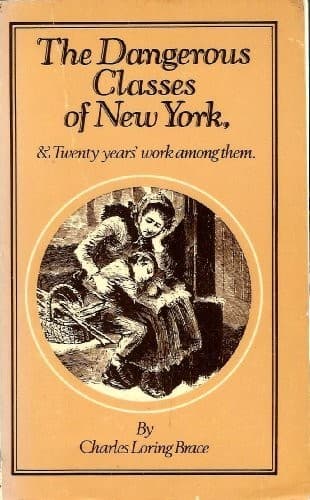
The Dangerous Classes of New York, and Twenty Years' Work Among ThemBrace, Charles Loring
History
The Dangerous Classes of New York, and Twenty Years' Work Among Them
Brace, Charles Loring
Child welfare -- New York (State) -- New York; New York (N.Y.) -- Social conditions; Poor -- New York (State) -- New York
Though our Free Schools are open to all, experience has taught that vast
numbers of children are so ill-clothed and destitute that they are
ashamed to attend these excellent places of instruction; or their
mothers are obliged to employ them during parts of the day; or they are
begging, or engaged in street occupations, and will not attend, or, if
they do, attend very irregularly. Very many are playing about the docks
or idling in the streets.
Twenty years ago, nothing seemed to check this evil. Captain Matsell, in
the celebrated report I have alluded to, estimated the number of vagrant
children as 10,000, and subsequently in later years, the estimate was as
high as 30,000. The commitments for vagrancy were enormous, reaching in
one year (1857), for females alone, 3,449; in 1859, 5,778; and in 1860,
5,880. In these we have not the exact number of children, but it was
certainly very large.
What was needed to check crime and vagrancy among young girls was some
School of Industry and Morals, adapted for the class.
Many were ashamed to go to the Public Schools; they were too irregular
for their rules. They needed some help in the way of food and clothing,
much direct moral instruction and training in industry; while their
mothers required to be stimulated by earnest appeals to their
consciences to induce them to school them at all. Agents must be sent
around to gather the children, and to persuade the parents to educate
their offspring. It was manifest that the Public Schools were not
adapted to meet all these wants, and indeed the mingling of any
eleemosynary features in our public educational establishments would
have been injudicious. As our infant Society had no funds, my effort was
to found something at first by outside help, with the hope subsequently
of obtaining a permanent support for the new enterprises, and bringing
them under the supervision of the parent Society.
The agencies which we sought to found were the INDUSTRIAL SCHOOLS, which
I shall now attempt to describe.
Each one of these humble charities has a history of its own--a history
known only to the poor--of sacrifice, patience, and labor.
Some of the most gifted women of New York, of high position and fortune,
as well as others of remarkable character and education, have poured
forth without stint their services of love in connection with these
ministrations of charity.
THE WILSON SCHOOL.
The School to which allusion has already been made on page 83, as
growing out of the Boys' Meeting in Sixth Street, and afterwards in
Avenue D, was the first of these Schools, and owes its origin especially
to a lady of great executive power, Mrs. Wilson, wife of the Rev. Dr.
Wilson. It has always been an exceedingly successful and efficient
School. It was formed in February, 1853, the writer assisting in its
organization, and was carried on outside of the Society whose history I
am sketching.
THE ROOKERIES OF THE FOURTH WARD--A REMEDY.
Public-domain text, read in full here on John Shaqi.
Reviews
Reviews
No reviews yet
Be the first to share your thoughts on this work.
Elsewhere in the archive
Join the Discussion
Join the discussion
Sign in to leave a comment or review.
Sign InorCreate an account