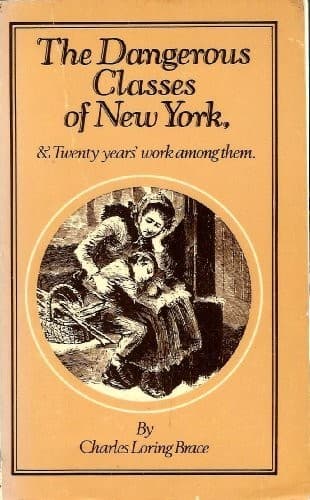
The Dangerous Classes of New York, and Twenty Years' Work Among ThemBrace, Charles Loring
History
The Dangerous Classes of New York, and Twenty Years' Work Among Them
Brace, Charles Loring
Child welfare -- New York (State) -- New York; New York (N.Y.) -- Social conditions; Poor -- New York (State) -- New York
In visiting from lane to lane and house to house in our poorest
quarters, I soon came to know one district which seemed hopelessly given
over to vice and misery--the region radiating out from or near to
Franklin Square, especially such streets as Cherry, Water, Dover,
Roosevelt, and the neighboring lanes. Here were huge barracks--one said
to contain some 1,500 persons--underground cellars, crowded with people,
and old rickety houses always having "a double" on the rear lot, so as
more effectually to shut out light and air. Here were as many
liquor-shops as houses, and those worst dens of vice, the
"Dance-Saloons," where prostitution was in its most brazen form, and the
unfortunate sailors were continually robbed or murdered. Nowhere in the
city were so many murders committed, or was every species of crime so
rife. Never, however, in this villainous quarter, did I experience the
slightest annoyance in my visits, nor did any one of the ladies who
subsequently ransacked every den and hole where a child could shelter
itself. My own attention was early arrested by the number of wild ragged
little girls who were flitting about through these lanes; some with
basket and poker gathering rags, some apparently seeking chances of
stealing, and others doing errands for the dance-saloons and brothels,
or hanging about their doors. The police were constantly arresting them
as "vagrants," when the mothers would beg them off from the good-natured
Justices, and promise to train them better in future. They were
evidently fast training, however, for the most abandoned life. It seemed
me if I could only get the refinement, education, and Christian
enthusiasm of the better classes fairly to work here among these
children, these terrible evils might be corrected at least for the next
generation.
I accordingly went about from house to house among ladies whom I had
known, and, representing the condition of the Ward, induced them to
attend a meeting of ladies to be held at the house of a prominent
physician, whose wife had kindly offered her rooms.
For some months I had attempted to prepare the public mind for these
labors by incessant writing for the daily papers, by lectures and by
sermons in various pulpits. Experience soon showed that the most
effective mode of making real the condition of the poorest class, was by
relating incidents from real life which continually presented
themselves.
The rich and fortunate had hardly conceived the histories of poverty,
suffering, and loneliness which were constantly passing around them.
Public-domain text, read in full here on John Shaqi.
Reviews
Reviews
No reviews yet
Be the first to share your thoughts on this work.
Elsewhere in the archive
Join the Discussion
Join the discussion
Sign in to leave a comment or review.
Sign InorCreate an account