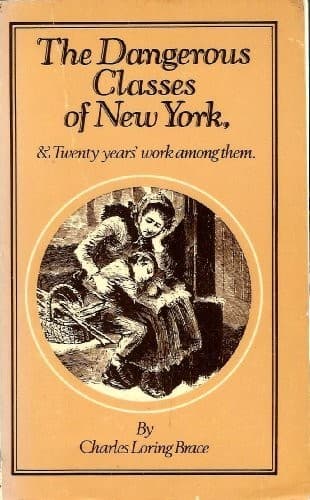
The Dangerous Classes of New York, and Twenty Years' Work Among ThemBrace, Charles Loring
History
The Dangerous Classes of New York, and Twenty Years' Work Among Them
Brace, Charles Loring
Child welfare -- New York (State) -- New York; New York (N.Y.) -- Social conditions; Poor -- New York (State) -- New York
The hope and effort of the writer was to connect the two extremes of
society in sympathy, and carry the forces of one class down to lift up
the other. For this two things were necessary--one to show the duty
which Christ especially teaches of sacrifice to the poor for His sake,
and the value which He attaches to each human soul; and the other to
free the whole, as much as possible, from any sectarian or dogmatic
character. Nothing but "the enthusiasm of humanity" inspired by Christ
could lead the comfortable and the fastidious to such disagreeable
scenes and hard labors as would meet them here. It was necessary to feel
that many comforts most be foregone, and much leisure given up, for this
important work. Very unpleasant sights were to be met with, coarse
people to be encountered, and rude children managed; the stern facts of
filth, vice, and crime to be dealt with.
It was not to be a mere holiday-work, or a sudden gush of sentiment;
but, to be of use, it must be patiently continued, week by week, and
month by month, and year by year, with some faint resemblance to that
patience and love which we believed a Higher One had exercised towards
us. But, with this inspiration, as carefully as possible, all dogmatic
limitation must be avoided. All sects were invited to take a share in
the work, and, as the efforts were necessarily directed to the most
palpable and terrible evils, the means used by all would be essentially
the same. Even those of no defined religious belief were gladly welcomed
if they were ready to do the offices of humanity. The fact that
ninety-nine hundredths of these poor people were Roman Catholics
compelled us also to confine ourselves to the most simple and
fundamental instructions, and to avoid, in any way, arousing religious
bigotry.
In the meeting, gathered at the house of Dr. P., were prominent ladies
from all the leading sects.
An address was delivered by the writer, and then a constitution
presented, of the simplest nature, and an association organized and
officers appointed by the ladies present. This was the foundation of
the
"FOURTH WARD INDUSTRIAL SCHOOL."
In the meanwhile, we went forth through the slums of the ward, and let
it be widely known that a School to teach work, and where food was given
daily, and clothes were bestowed to the well-behaved, was just forming.
Our room was in the basement of a church in Roosevelt Street. Hither
gathered, on a morning in December, 1853, our ladies and a flock of the
most ill-clad and wildest little street-girls that could be collected
anywhere in New York. They flew over the benches, they swore and fought
with one another, they bandied vile language, and could hardly be tamed
down sufficiently to allow the school to be opened.
Public-domain text, read in full here on John Shaqi.
Reviews
Reviews
No reviews yet
Be the first to share your thoughts on this work.
Elsewhere in the archive
Join the Discussion
Join the discussion
Sign in to leave a comment or review.
Sign InorCreate an account