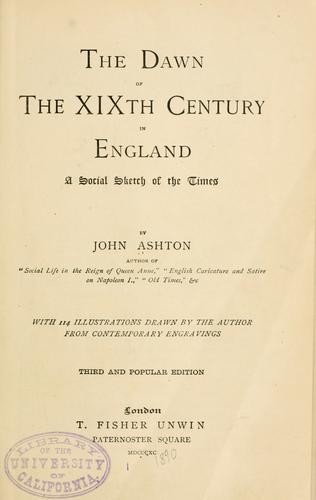
The Dawn of the XIXth Century in England: A social sketch of the timesAshton, John
History
The Dawn of the XIXth Century in England: A social sketch of the times
Ashton, John
England -- Social life and customs -- 19th century
“Two wings of the pillory were then taken off to place Cooke and
Amos in, who, although they came in only for the second course, had
no reason to complain of short allowance. The vengeance of the crowd
pursued them back to Newgate, and the caravan was filled with mud and
ordure.
“No interference from the Sheriffs and police officers could restrain
the popular rage; but, notwithstanding the immensity of the multitude,
no accident of any note occurred.”
[Illustration]
[Illustration]
CHAPTER LII.
Smuggling—An exciting smuggling adventure—The Brighton fishermen
and the Excise—“Body-snatching”—“Benefit of Clergy”—Tyburn
tickets—Death the penalty for many crimes—“Last dying Speech”—The
“condemned pew” at Newgate—Horrible execution at Jersey—The new
drop—An impenitent criminal.
THE OFFENCE of Smuggling, now all but died out, was common enough,
and people in very good positions in life thought it no harm to, at
least, indirectly participate in it. The feats of smugglers were of
such every-day occurrence, that they were seldom recorded in the
papers, unless there were some peculiar circumstances about them, such
as shooting an excise man, or the like. In one paper, however, the
_Morning Post_, September 3, 1801, there are two cases, one only of
which I shall transcribe. “A singular circumstance occurred on Tuesday
last, at King Harry Passage, Cornwall. A smuggler, with two ankers of
brandy on the horse under him, was discovered by an exciseman, also on
horseback, on the road leading to the Passage. The smuggler immediately
rode off at full speed, pursued by the officer, who pressed so close
upon him, that, after rushing down the steep hill to the Passage,
with the greatest rapidity, he plunged his horse into the water, and
attempted to gain the opposite shore. The horse had not swam half way
over, before, exhausted with fatigue, and the load on his back, he was
on the point of sinking, when the intrepid rider slid from his back,
and, with his knife, cut the slings of the ankers, and swam alongside
his horse, exerting himself to keep his head above water, but all to no
purpose; the horse was drowned, and the man, with difficulty, reached
the shore. The less mettlesome exciseman had halted on the shore, where
he surveyed the ineffectual struggle, and, afterwards, with the help of
the ferryman, got possession of the ankers.”
Public-domain text, read in full here on John Shaqi.
Reviews
Reviews
No reviews yet
Be the first to share your thoughts on this work.
Elsewhere in the archive
Join the Discussion
Join the discussion
Sign in to leave a comment or review.
Sign InorCreate an account