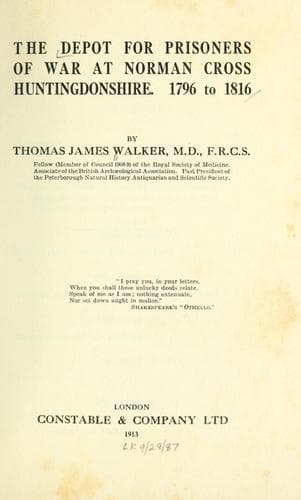
The Depot for Prisoners of War at Norman Cross, Huntingdonshire. 1796 to 1816Walker, Thomas (Thomas James)
History
The Depot for Prisoners of War at Norman Cross, Huntingdonshire. 1796 to 1816
Walker, Thomas (Thomas James)
France -- History -- 1789-1815; Norman Cross depot; Prisoners of war
Wellington, replying 4th September 1813 to an application from Mr. J. S.
Larpent requesting the General to obtain his release from captivity,
wrote:
“In this war, which on account of the violence of animosity with
which it is conducted, it is to be hoped will be the last, for some
time at least, everybody taken is considered a prisoner of war, and
none are released without exchange. There are several persons, now
in _my_ power, in the same situation as yourself in that respect,
that is to say, non-combatants according to the known and anciently
practised rules of war; among others there is the secretary of the
Governor of San Sebastian. . . .” {218}
Such being the spirit of the war, negotiations for exchange continually
fell through.
In the early period it was the want of good faith on the part of the
French, and the unfairness with which the exchange was conducted by them,
that on more than one occasion put a stop to the general exchange which
was going on. Thus in 1798, when a general exchange had been arranged,
and the Depot at Norman Cross was rapidly emptying, the _Samaritan_
cartel took 201 French prisoners to France, but returned with only 71
British. The _Britannia_ carried over 150, and 450 were conveyed by two
other cartels; the three returned without a single British prisoner. The
captains of the vessels were told that there were no British prisoners to
return, and they were ordered to sea at once, regardless of wind or
weather.
During the early negotiations a return was furnished to show what had
been the result of the general exchange up to the date when fresh
arrangements were to be made, and it appeared that 6,056 British
prisoners had been received from France, while she had received from the
British 16,334, including 4,986 captured at Martinique and Guadeloupe.
On 19th March 1798 by the fresh exchange France had received 12,543,
Britain only 5,045, leaving a balance of 7,498 due to England. The
earliest prisoners to be exchanged from Norman Cross left on 24th August
1797, only four months after the first prisoners had been received there.
The contingent was sent to Lynn; it numbered 305, and consisted of 7
captains of privateers, 4 sergeants, 6 corporals, 148 soldiers, 127
seamen and 7 boys, and 6 not specified. They sailed in the _Rosine_,
which had brought the same number of British to England.
The article of the agreement providing that the prisoners for exchange
were not to be selected, but were to be taken according to the priority
of their capture, was afterwards modified, so as to select the aged, the
infirm, such as were not seamen, and boys under twelve years of age!
Amid all the bickering and obstinacy on both sides in the negotiations as
to the treatment and exchange of the prisoners, there is one instance
which shows that the chivalrous spirit of the French was not dead.
Public-domain text, read in full here on John Shaqi.
Reviews
Reviews
No reviews yet
Be the first to share your thoughts on this work.
Elsewhere in the archive
Join the Discussion
Join the discussion
Sign in to leave a comment or review.
Sign InorCreate an account