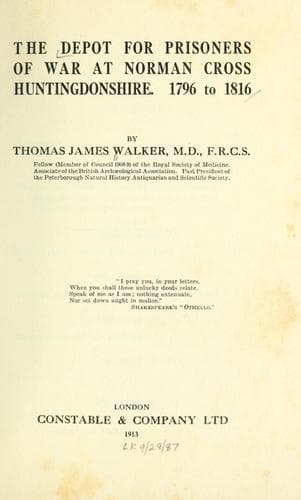
The Depot for Prisoners of War at Norman Cross, Huntingdonshire. 1796 to 1816Walker, Thomas (Thomas James)
History
The Depot for Prisoners of War at Norman Cross, Huntingdonshire. 1796 to 1816
Walker, Thomas (Thomas James)
France -- History -- 1789-1815; Norman Cross depot; Prisoners of war
The landlord of the Old Bell Inn, still in the glory of the coaching and
posting days, apparently treated for the wooden building, containing the
two houses occupied one by Captain Woodriff the agent and the other by
the steward and another officer, the rental of Captain Woodriff’s house
to be £12 and that adjoining £10; but even at that rent he did not close.
In January 1803 the whole was let to Mr. Henderson, on condition that he
lived on the premises, the barrack master keeping one key of the great
gate. Mr. Henderson paid an extra sum of £10 for Captain Woodriff’s
house, which he probably wished to fit up either for his own residence or
for the man whom he proposed to leave in charge when he was in London
attending to another business which he had there; he also agreed to level
the huts, which are not represented on any of the plans, and to sow the
ground covered by them with grass seeds.
His tenancy lasted only six months. Hostilities recommenced in May 1803,
and on 3rd July Henderson had to hand over everything to two clerks
appointed by the Admiralty. He pleaded that he had ploughed and sown
crops, and claimed £30 18_s._ compensation; he received £18 13_s._ On
the whole the Government would probably have saved money if they had
locked the gates when Captain Woodriff, their agent, left the empty depot
in June 1802, kept the keys themselves, and unlocked them on the 3rd July
1803.
Between those dates much had taken place to affect the history of the
Depot. The complete supremacy of the British Fleet, the blow given to
the Northern Alliance (the Armed Neutrality) by Nelson in the battle of
Copenhagen, and on the other hand the defeats inflicted on Austria,
England’s continental ally, on whom she relied for her land forces, and
the consequent Treaty of Lunéville, left England and France alike in a
position which made them in 1802 anxious for a cessation of hostilities,
the Treaty of Amiens being the result.
Public-domain text, read in full here on John Shaqi.
Reviews
Reviews
No reviews yet
Be the first to share your thoughts on this work.
Elsewhere in the archive