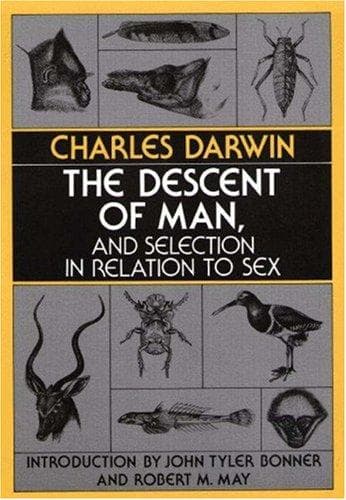
The Descent of Man, and Selection in Relation to SexDarwin, Charles
History
The Descent of Man, and Selection in Relation to Sex
Darwin, Charles
Evolution (Biology); Human beings -- Origin; Sex differences; Sexual dimorphism (Animals); Sexual selection in animals
Man is liable to receive from the lower animals, and to communicate to
them, certain diseases, as hydrophobia, variola, the glanders,
syphilis, cholera, herpes, etc. (3. Dr. W. Lauder Lindsay has treated
this subject at some length in the ‘Journal of Mental Science,’ July
1871; and in the ‘Edinburgh Veterinary Review,’ July 1858.); and this
fact proves the close similarity (4. A Reviewer has criticised
(‘British Quarterly Review,’ Oct. 1st, 1871, page 472) what I have here
said with much severity and contempt; but as I do not use the term
identity, I cannot see that I am greatly in error. There appears to me
a strong analogy between the same infection or contagion producing the
same result, or one closely similar, in two distinct animals, and the
testing of two distinct fluids by the same chemical reagent.) of their
tissues and blood, both in minute structure and composition, far more
plainly than does their comparison under the best microscope, or by the
aid of the best chemical analysis. Monkeys are liable to many of the
same non-contagious diseases as we are; thus Rengger (5.
‘Naturgeschichte der Säugethiere von Paraguay,’ 1830, s. 50.), who
carefully observed for a long time the Cebus Azarae in its native land,
found it liable to catarrh, with the usual symptoms, and which, when
often recurrent, led to consumption. These monkeys suffered also from
apoplexy, inflammation of the bowels, and cataract in the eye. The
younger ones when shedding their milk-teeth often died from fever.
Medicines produced the same effect on them as on us. Many kinds of
monkeys have a strong taste for tea, coffee, and spiritous liquors:
they will also, as I have myself seen, smoke tobacco with pleasure. (6.
The same tastes are common to some animals much lower in the scale. Mr.
A. Nichols informs me that he kept in Queensland, in Australia, three
individuals of the Phaseolarctus cinereus; and that, without having
been taught in any way, they acquired a strong taste for rum, and for
smoking tobacco.) Brehm asserts that the natives of north-eastern
Africa catch the wild baboons by exposing vessels with strong beer, by
which they are made drunk. He has seen some of these animals, which he
kept in confinement, in this state; and he gives a laughable account of
their behaviour and strange grimaces. On the following morning they
were very cross and dismal; they held their aching heads with both
hands, and wore a most pitiable expression: when beer or wine was
offered them, they turned away with disgust, but relished the juice of
lemons. (7. Brehm, ‘Thierleben,’ B. i. 1864, s. 75, 86. On the Ateles,
s. 105. For other analogous statements, see s. 25, 107.) An American
monkey, an Ateles, after getting drunk on brandy, would never touch it
again, and thus was wiser than many men. These trifling facts prove how
similar the nerves of taste must be in monkeys and man, and how
similarly their whole nervous system is affected.
Public-domain text, read in full here on John Shaqi.
Reviews
Reviews
No reviews yet
Be the first to share your thoughts on this work.
Join the Discussion
Join the discussion
Sign in to leave a comment or review.
Sign InorCreate an account