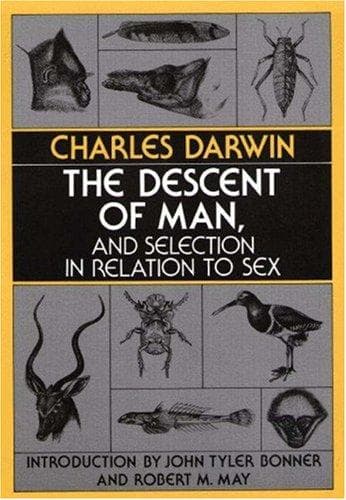
The Descent of Man, and Selection in Relation to SexDarwin, Charles
History
The Descent of Man, and Selection in Relation to Sex
Darwin, Charles
Evolution (Biology); Human beings -- Origin; Sex differences; Sexual dimorphism (Animals); Sexual selection in animals
Man is infested with internal parasites, sometimes causing fatal
effects; and is plagued by external parasites, all of which belong to
the same genera or families as those infesting other mammals, and in
the case of scabies to the same species. (8. Dr. W. Lauder Lindsay,
‘Edinburgh Vet. Review,’ July 1858, page 13.) Man is subject, like
other mammals, birds, and even insects (9. With respect to insects see
Dr. Laycock, “On a General Law of Vital Periodicity,” ‘British
Association,’ 1842. Dr. Macculloch, ‘Silliman’s North American Journal
of Science,’ vol. XVII. page 305, has seen a dog suffering from tertian
ague. Hereafter I shall return to this subject.), to that mysterious
law, which causes certain normal processes, such as gestation, as well
as the maturation and duration of various diseases, to follow lunar
periods. His wounds are repaired by the same process of healing; and
the stumps left after the amputation of his limbs, especially during an
early embryonic period, occasionally possess some power of
regeneration, as in the lowest animals. (10. I have given the evidence
on this head in my ‘Variation of Animals and Plants under
Domestication,’ vol. ii. page 15, and more could be added.)
The whole process of that most important function, the reproduction of
the species, is strikingly the same in all mammals, from the first act
of courtship by the male (11. Mares e diversis generibus Quadrumanorum
sine dubio dignoscunt feminas humanas a maribus. Primum, credo,
odoratu, postea aspectu. Mr. Youatt, qui diu in Hortis Zoologicis
(Bestiariis) medicus animalium erat, vir in rebus observandis cautus et
sagax, hoc mihi certissime probavit, et curatores ejusdem loci et alii
e ministris confirmaverunt. Sir Andrew Smith et Brehm notabant idem in
Cynocephalo. Illustrissimus Cuvier etiam narrat multa de hac re, qua ut
opinor, nihil turpius potest indicari inter omnia hominibus et
Quadrumanis communia. Narrat enim Cynocephalum quendam in furorem
incidere aspectu feminarum aliquarem, sed nequaquam accendi tanto
furore ab omnibus. Semper eligebat juniores, et dignoscebat in turba,
et advocabat voce gestuque.), to the birth and nurturing of the young.
Monkeys are born in almost as helpless a condition as our own infants;
and in certain genera the young differ fully as much in appearance from
the adults, as do our children from their full-grown parents. (12. This
remark is made with respect to Cynocephalus and the anthropomorphous
apes by Geoffroy Saint-Hilaire and F. Cuvier, ‘Histoire Nat. des
Mammifères,’ tom. i. 1824.) It has been urged by some writers, as an
important distinction, that with man the young arrive at maturity at a
much later age than with any other animal: but if we look to the races
of mankind which inhabit tropical countries the difference is not
great, for the orang is believed not to be adult till the age of from
ten to fifteen years. (13. Huxley, ‘Man’s Place in Nature,’ 1863, p.
Public-domain text, read in full here on John Shaqi.
Reviews
Reviews
No reviews yet
Be the first to share your thoughts on this work.
Join the Discussion
Join the discussion
Sign in to leave a comment or review.
Sign InorCreate an account