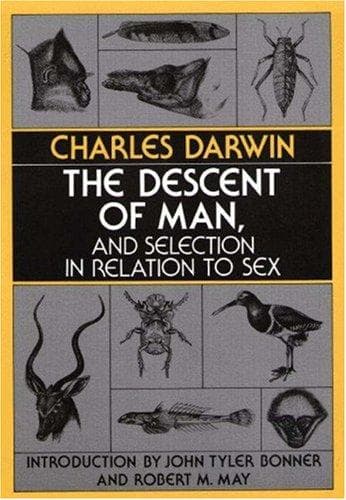
The Descent of Man, and Selection in Relation to SexDarwin, Charles
History
The Descent of Man, and Selection in Relation to Sex
Darwin, Charles
Evolution (Biology); Human beings -- Origin; Sex differences; Sexual dimorphism (Animals); Sexual selection in animals
and three, eggs not nearly hatched. Many birds, not yet old enough for
a prolonged flight, are likewise deserted and left behind. See
Blackwall, ‘Researches in Zoology,’ 1834, pp. 108, 118. For some
additional evidence, although this is not wanted, see Leroy, ‘Lettres
Phil.’ 1802, p. 217. For Swifts, Gould’s ‘Introduction to the Birds of
Great Britain,’ 1823, p. 5. Similar cases have been observed in Canada
by Mr. Adams; ‘Pop. Science Review,’ July 1873, p. 283.)
We can perceive that an instinctive impulse, if it be in any way more
beneficial to a species than some other or opposed instinct, would be
rendered the more potent of the two through natural selection; for the
individuals which had it most strongly developed would survive in
larger numbers. Whether this is the case with the migratory in
comparison with the maternal instinct, may be doubted. The great
persistence, or steady action of the former at certain seasons of the
year during the whole day, may give it for a time paramount force.
MAN A SOCIAL ANIMAL.
Every one will admit that man is a social being. We see this in his
dislike of solitude, and in his wish for society beyond that of his own
family. Solitary confinement is one of the severest punishments which
can be inflicted. Some authors suppose that man primevally lived in
single families; but at the present day, though single families, or
only two or three together, roam the solitudes of some savage lands,
they always, as far as I can discover, hold friendly relations with
other families inhabiting the same district. Such families occasionally
meet in council, and unite for their common defence. It is no argument
against savage man being a social animal, that the tribes inhabiting
adjacent districts are almost always at war with each other; for the
social instincts never extend to all the individuals of the same
species. Judging from the analogy of the majority of the Quadrumana, it
is probable that the early ape-like progenitors of man were likewise
social; but this is not of much importance for us. Although man, as he
now exists, has few special instincts, having lost any which his early
progenitors may have possessed, this is no reason why he should not
have retained from an extremely remote period some degree of
instinctive love and sympathy for his fellows. We are indeed all
conscious that we do possess such sympathetic feelings (23. Hume
remarks (‘An Enquiry Concerning the Principles of Morals,’ edit. of
1751, p. 132), “There seems a necessity for confessing that the
happiness and misery of others are not spectacles altogether
indifferent to us, but that the view of the former...communicates a
secret joy; the appearance of the latter... throws a melancholy damp
over the imagination.”); but our consciousness does not tell us whether
they are instinctive, having originated long ago in the same manner as
with the lower animals, or whether they have been acquired by each of
us during our early years.
Public-domain text, read in full here on John Shaqi.
Reviews
Reviews
No reviews yet
Be the first to share your thoughts on this work.
Elsewhere in the archive
Join the Discussion
Join the discussion
Sign in to leave a comment or review.
Sign InorCreate an account