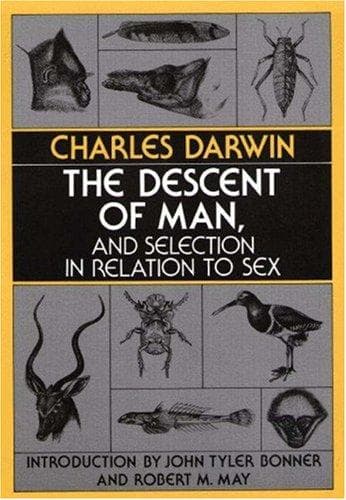
The Descent of Man, and Selection in Relation to SexDarwin, Charles
History
The Descent of Man, and Selection in Relation to Sex
Darwin, Charles
Evolution (Biology); Human beings -- Origin; Sex differences; Sexual dimorphism (Animals); Sexual selection in animals
As man is a social animal, it is almost
certain that he would inherit a tendency to be faithful to his
comrades, and obedient to the leader of his tribe; for these qualities
are common to most social animals. He would consequently possess some
capacity for self-command. He would from an inherited tendency be
willing to defend, in concert with others, his fellow-men; and would be
ready to aid them in any way, which did not too greatly interfere with
his own welfare or his own strong desires.
The social animals which stand at the bottom of the scale are guided
almost exclusively, and those which stand higher in the scale are
largely guided, by special instincts in the aid which they give to the
members of the same community; but they are likewise in part impelled
by mutual love and sympathy, assisted apparently by some amount of
reason. Although man, as just remarked, has no special instincts to
tell him how to aid his fellow-men, he still has the impulse, and with
his improved intellectual faculties would naturally be much guided in
this respect by reason and experience. Instinctive sympathy would also
cause him to value highly the approbation of his fellows; for, as Mr.
Bain has clearly shewn (24. ‘Mental and Moral Science,’ 1868, p. 254.),
the love of praise and the strong feeling of glory, and the still
stronger horror of scorn and infamy, “are due to the workings of
sympathy.” Consequently man would be influenced in the highest degree
by the wishes, approbation, and blame of his fellow-men, as expressed
by their gestures and language. Thus the social instincts, which must
have been acquired by man in a very rude state, and probably even by
his early ape-like progenitors, still give the impulse to some of his
best actions; but his actions are in a higher degree determined by the
expressed wishes and judgment of his fellow-men, and unfortunately very
often by his own strong selfish desires. But as love, sympathy and
self-command become strengthened by habit, and as the power of
reasoning becomes clearer, so that man can value justly the judgments
of his fellows, he will feel himself impelled, apart from any
transitory pleasure or pain, to certain lines of conduct. He might then
declare—not that any barbarian or uncultivated man could thus think—I
am the supreme judge of my own conduct, and in the words of Kant, I
will not in my own person violate the dignity of humanity.
THE MORE ENDURING SOCIAL INSTINCTS CONQUER THE LESS PERSISTENT
INSTINCTS.
We have not, however, as yet considered the main point, on which, from
our present point of view, the whole question of the moral sense turns.
Why should a man feel that he ought to obey one instinctive desire
rather than another? Why is he bitterly regretful, if he has yielded to
a strong sense of self-preservation, and has not risked his life to
save that of a fellow-creature? or why does he regret having stolen
food from hunger?
Public-domain text, read in full here on John Shaqi.
Reviews
Reviews
No reviews yet
Be the first to share your thoughts on this work.
Elsewhere in the archive
Join the Discussion
Join the discussion
Sign in to leave a comment or review.
Sign InorCreate an account