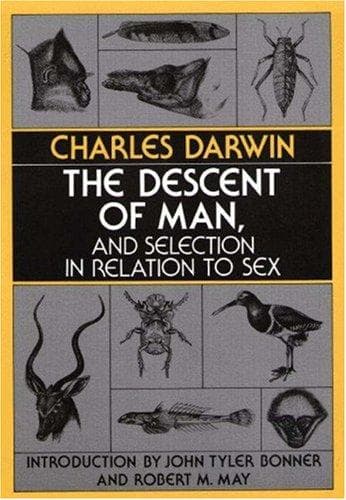
The Descent of Man, and Selection in Relation to SexDarwin, Charles
History
The Descent of Man, and Selection in Relation to Sex
Darwin, Charles
Evolution (Biology); Human beings -- Origin; Sex differences; Sexual dimorphism (Animals); Sexual selection in animals
It is evident in the first place, that with mankind the instinctive
impulses have different degrees of strength; a savage will risk his own
life to save that of a member of the same community, but will be wholly
indifferent about a stranger: a young and timid mother urged by the
maternal instinct will, without a moment’s hesitation, run the greatest
danger for her own infant, but not for a mere fellow-creature.
Nevertheless many a civilised man, or even boy, who never before risked
his life for another, but full of courage and sympathy, has disregarded
the instinct of self-preservation, and plunged at once into a torrent
to save a drowning man, though a stranger. In this case man is impelled
by the same instinctive motive, which made the heroic little American
monkey, formerly described, save his keeper, by attacking the great and
dreaded baboon. Such actions as the above appear to be the simple
result of the greater strength of the social or maternal instincts
rather than that of any other instinct or motive; for they are
performed too instantaneously for reflection, or for pleasure or pain
to be felt at the time; though, if prevented by any cause, distress or
even misery might be felt. In a timid man, on the other hand, the
instinct of self-preservation might be so strong, that he would be
unable to force himself to run any such risk, perhaps not even for his
own child.
I am aware that some persons maintain that actions performed
impulsively, as in the above cases, do not come under the dominion of
the moral sense, and cannot be called moral. They confine this term to
actions done deliberately, after a victory over opposing desires, or
when prompted by some exalted motive. But it appears scarcely possible
to draw any clear line of distinction of this kind. (25. I refer here
to the distinction between what has been called MATERIAL and FORMAL
morality. I am glad to find that Professor Huxley (‘Critiques and
Addresses,’ 1873, p. 287) takes the same view on this subject as I do.
Mr. Leslie Stephen remarks (‘Essays on Freethinking and Plain
Speaking,’ 1873, p. 83), “the metaphysical distinction, between
material and formal morality is as irrelevant as other such
distinctions.”) As far as exalted motives are concerned, many instances
have been recorded of savages, destitute of any feeling of general
benevolence towards mankind, and not guided by any religious motive,
who have deliberately sacrificed their lives as prisoners(26. I have
given one such case, namely of three Patagonian Indians who preferred
being shot, one after the other, to betraying the plans of their
companions in war (‘Journal of Researches,’ 1845, p. 103).), rather
than betray their comrades; and surely their conduct ought to be
considered as moral. As far as deliberation, and the victory over
opposing motives are concerned, animals may be seen doubting between
opposed instincts, in rescuing their offspring or comrades from danger;
Public-domain text, read in full here on John Shaqi.
Reviews
Reviews
No reviews yet
Be the first to share your thoughts on this work.
Elsewhere in the archive
Join the Discussion
Join the discussion
Sign in to leave a comment or review.
Sign InorCreate an account