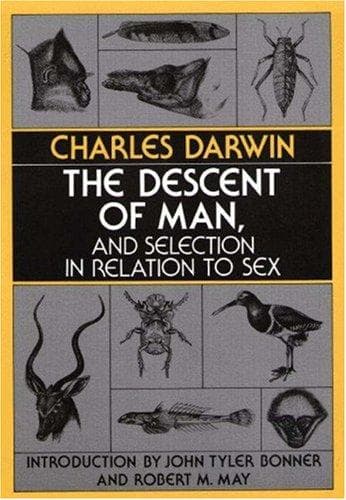
The Descent of Man, and Selection in Relation to SexDarwin, Charles
History
The Descent of Man, and Selection in Relation to Sex
Darwin, Charles
Evolution (Biology); Human beings -- Origin; Sex differences; Sexual dimorphism (Animals); Sexual selection in animals
yet their actions, though done for the good of others, are not called
moral. Moreover, anything performed very often by us, will at last be
done without deliberation or hesitation, and can then hardly be
distinguished from an instinct; yet surely no one will pretend that
such an action ceases to be moral. On the contrary, we all feel that an
act cannot be considered as perfect, or as performed in the most noble
manner, unless it be done impulsively, without deliberation or effort,
in the same manner as by a man in whom the requisite qualities are
innate. He who is forced to overcome his fear or want of sympathy
before he acts, deserves, however, in one way higher credit than the
man whose innate disposition leads him to a good act without effort. As
we cannot distinguish between motives, we rank all actions of a certain
class as moral, if performed by a moral being. A moral being is one who
is capable of comparing his past and future actions or motives, and of
approving or disapproving of them. We have no reason to suppose that
any of the lower animals have this capacity; therefore, when a
Newfoundland dog drags a child out of the water, or a monkey faces
danger to rescue its comrade, or takes charge of an orphan monkey, we
do not call its conduct moral. But in the case of man, who alone can
with certainty be ranked as a moral being, actions of a certain class
are called moral, whether performed deliberately, after a struggle with
opposing motives, or impulsively through instinct, or from the effects
of slowly-gained habit.
But to return to our more immediate subject. Although some instincts
are more powerful than others, and thus lead to corresponding actions,
yet it is untenable, that in man the social instincts (including the
love of praise and fear of blame) possess greater strength, or have,
through long habit, acquired greater strength than the instincts of
self-preservation, hunger, lust, vengeance, etc. Why then does man
regret, even though trying to banish such regret, that he has followed
the one natural impulse rather than the other; and why does he further
feel that he ought to regret his conduct? Man in this respect differs
profoundly from the lower animals. Nevertheless we can, I think, see
with some degree of clearness the reason of this difference.
Public-domain text, read in full here on John Shaqi.
Reviews
Reviews
No reviews yet
Be the first to share your thoughts on this work.
Elsewhere in the archive
Join the Discussion
Join the discussion
Sign in to leave a comment or review.
Sign InorCreate an account