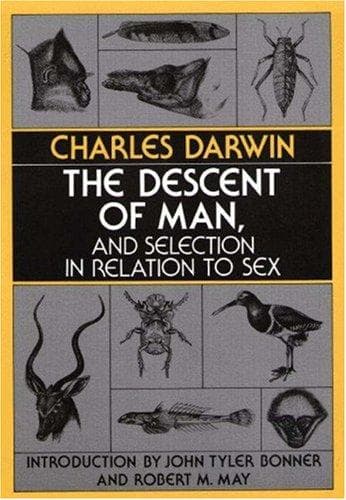
The Descent of Man, and Selection in Relation to SexDarwin, Charles
History
The Descent of Man, and Selection in Relation to Sex
Darwin, Charles
Evolution (Biology); Human beings -- Origin; Sex differences; Sexual dimorphism (Animals); Sexual selection in animals
The other so-called self-regarding virtues, which do not obviously,
though they may really, affect the welfare of the tribe, have never
been esteemed by savages, though now highly appreciated by civilised
nations. The greatest intemperance is no reproach with savages. Utter
licentiousness, and unnatural crimes, prevail to an astounding extent.
(36. Mr. M’Lennan has given (‘Primitive Marriage,’ 1865, p. 176) a good
collection of facts on this head.) As soon, however, as marriage,
whether polygamous, or monogamous, becomes common, jealousy will lead
to the inculcation of female virtue; and this, being honoured, will
tend to spread to the unmarried females. How slowly it spreads to the
male sex, we see at the present day. Chastity eminently requires
self-command; therefore it has been honoured from a very early period
in the moral history of civilised man. As a consequence of this, the
senseless practice of celibacy has been ranked from a remote period as
a virtue. (38. Lecky, ‘History of European Morals,’ vol. i. 1869, p.
109.) The hatred of indecency, which appears to us so natural as to be
thought innate, and which is so valuable an aid to chastity, is a
modern virtue, appertaining exclusively, as Sir G. Staunton remarks
(38. ‘Embassy to China,’ vol. ii. p. 348.), to civilised life. This is
shewn by the ancient religious rites of various nations, by the
drawings on the walls of Pompeii, and by the practices of many savages.
We have now seen that actions are regarded by savages, and were
probably so regarded by primeval man, as good or bad, solely as they
obviously affect the welfare of the tribe,—not that of the species, nor
that of an individual member of the tribe. This conclusion agrees well
with the belief that the so-called moral sense is aboriginally derived
from the social instincts, for both relate at first exclusively to the
community.
The chief causes of the low morality of savages, as judged by our
standard, are, firstly, the confinement of sympathy to the same tribe.
Secondly, powers of reasoning insufficient to recognise the bearing of
many virtues, especially of the self-regarding virtues, on the general
welfare of the tribe. Savages, for instance, fail to trace the
multiplied evils consequent on a want of temperance, chastity, etc.
And, thirdly, weak power of self-command; for this power has not been
strengthened through long-continued, perhaps inherited, habit,
instruction and religion.
Public-domain text, read in full here on John Shaqi.
Reviews
Reviews
No reviews yet
Be the first to share your thoughts on this work.
Elsewhere in the archive
Join the Discussion
Join the discussion
Sign in to leave a comment or review.
Sign InorCreate an account