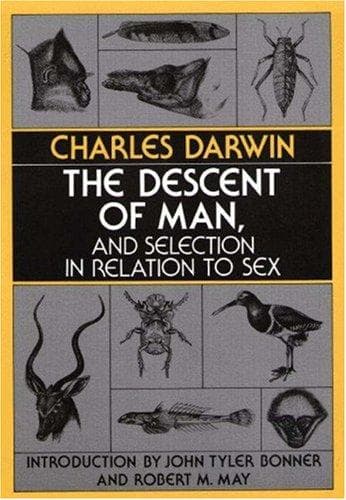
The Descent of Man, and Selection in Relation to SexDarwin, Charles
History
The Descent of Man, and Selection in Relation to Sex
Darwin, Charles
Evolution (Biology); Human beings -- Origin; Sex differences; Sexual dimorphism (Animals); Sexual selection in animals
I have entered into the above details on the immorality of savages (39.
See on this subject copious evidence in Chap. vii. of Sir J. Lubbock,
‘Origin of Civilisation,’ 1870.), because some authors have recently
taken a high view of their moral nature, or have attributed most of
their crimes to mistaken benevolence. (40. For instance Lecky, ‘History
of European Morals,’ vol. i. p. 124.) These authors appear to rest
their conclusion on savages possessing those virtues which are
serviceable, or even necessary, for the existence of the family and of
the tribe,—qualities which they undoubtedly do possess, and often in a
high degree.
CONCLUDING REMARKS.
It was assumed formerly by philosophers of the derivative (41. This
term is used in an able article in the ‘Westminster Review,’ Oct. 1869,
p. 498. For the “Greatest happiness principle,” see J.S. Mill,
‘Utilitarianism,’ p. 17.) school of morals that the foundation of
morality lay in a form of Selfishness; but more recently the “Greatest
happiness principle” has been brought prominently forward. It is,
however, more correct to speak of the latter principle as the standard,
and not as the motive of conduct. Nevertheless, all the authors whose
works I have consulted, with a few exceptions (42. Mill recognises
(‘System of Logic,’ vol. ii. p. 422) in the clearest manner, that
actions may be performed through habit without the anticipation of
pleasure. Mr. H. Sidgwick also, in his Essay on Pleasure and Desire
(‘The Contemporary Review,’ April 1872, p. 671), remarks: “To sum up,
in contravention of the doctrine that our conscious active impulses are
always directed towards the production of agreeable sensations in
ourselves, I would maintain that we find everywhere in consciousness
extra-regarding impulse, directed towards something that is not
pleasure; that in many cases the impulse is so far incompatible with
the self-regarding that the two do not easily co-exist in the same
moment of consciousness.” A dim feeling that our impulses do not by any
means always arise from any contemporaneous or anticipated pleasure,
has, I cannot but think, been one chief cause of the acceptance of the
intuitive theory of morality, and of the rejection of the utilitarian
or “Greatest happiness” theory. With respect to the latter theory the
standard and the motive of conduct have no doubt often been confused,
but they are really in some degree blended.), write as if there must be
a distinct motive for every action, and that this must be associated
with some pleasure or displeasure. But man seems often to act
impulsively, that is from instinct or long habit, without any
consciousness of pleasure, in the same manner as does probably a bee or
ant, when it blindly follows its instincts. Under circumstances of
extreme peril, as during a fire, when a man endeavours to save a
fellow-creature without a moment’s hesitation, he can hardly feel
pleasure; and still less has he time to reflect on the dissatisfaction
Public-domain text, read in full here on John Shaqi.
Reviews
Reviews
No reviews yet
Be the first to share your thoughts on this work.
Elsewhere in the archive
Join the Discussion
Join the discussion
Sign in to leave a comment or review.
Sign InorCreate an account