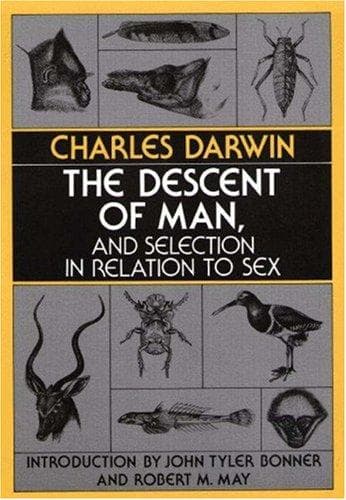
The Descent of Man, and Selection in Relation to SexDarwin, Charles
History
The Descent of Man, and Selection in Relation to Sex
Darwin, Charles
Evolution (Biology); Human beings -- Origin; Sex differences; Sexual dimorphism (Animals); Sexual selection in animals
which he might subsequently experience if he did not make the attempt.
Should he afterwards reflect over his own conduct, he would feel that
there lies within him an impulsive power widely different from a search
after pleasure or happiness; and this seems to be the deeply planted
social instinct.
In the case of the lower animals it seems much more appropriate to
speak of their social instincts, as having been developed for the
general good rather than for the general happiness of the species. The
term, general good, may be defined as the rearing of the greatest
number of individuals in full vigour and health, with all their
faculties perfect, under the conditions to which they are subjected. As
the social instincts both of man and the lower animals have no doubt
been developed by nearly the same steps, it would be advisable, if
found practicable, to use the same definition in both cases, and to
take as the standard of morality, the general good or welfare of the
community, rather than the general happiness; but this definition would
perhaps require some limitation on account of political ethics.
When a man risks his life to save that of a fellow-creature, it seems
also more correct to say that he acts for the general good, rather than
for the general happiness of mankind. No doubt the welfare and the
happiness of the individual usually coincide; and a contented, happy
tribe will flourish better than one that is discontented and unhappy.
We have seen that even at an early period in the history of man, the
expressed wishes of the community will have naturally influenced to a
large extent the conduct of each member; and as all wish for happiness,
the “greatest happiness principle” will have become a most important
secondary guide and object; the social instinct, however, together with
sympathy (which leads to our regarding the approbation and
disapprobation of others), having served as the primary impulse and
guide. Thus the reproach is removed of laying the foundation of the
noblest part of our nature in the base principle of selfishness;
unless, indeed, the satisfaction which every animal feels, when it
follows its proper instincts, and the dissatisfaction felt when
prevented, be called selfish.
Public-domain text, read in full here on John Shaqi.
Reviews
Reviews
No reviews yet
Be the first to share your thoughts on this work.
Elsewhere in the archive
Join the Discussion
Join the discussion
Sign in to leave a comment or review.
Sign InorCreate an account