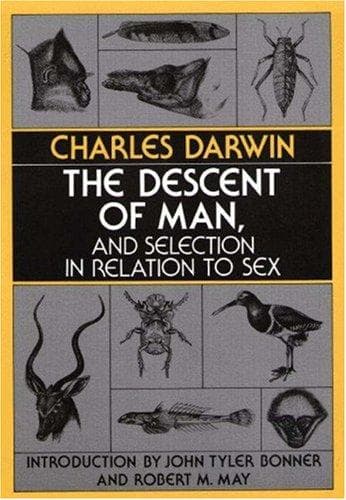
The Descent of Man, and Selection in Relation to SexDarwin, Charles
History
The Descent of Man, and Selection in Relation to Sex
Darwin, Charles
Evolution (Biology); Human beings -- Origin; Sex differences; Sexual dimorphism (Animals); Sexual selection in animals
The wishes and opinions of the members of the same community, expressed
at first orally, but later by writing also, either form the sole guides
of our conduct, or greatly reinforce the social instincts; such
opinions, however, have sometimes a tendency directly opposed to these
instincts. This latter fact is well exemplified by the LAW OF HONOUR,
that is, the law of the opinion of our equals, and not of all our
countrymen. The breach of this law, even when the breach is known to be
strictly accordant with true morality, has caused many a man more agony
than a real crime. We recognise the same influence in the burning sense
of shame which most of us have felt, even after the interval of years,
when calling to mind some accidental breach of a trifling, though
fixed, rule of etiquette. The judgment of the community will generally
be guided by some rude experience of what is best in the long run for
all the members; but this judgment will not rarely err from ignorance
and weak powers of reasoning. Hence the strangest customs and
superstitions, in complete opposition to the true welfare and happiness
of mankind, have become all-powerful throughout the world. We see this
in the horror felt by a Hindoo who breaks his caste, and in many other
such cases. It would be difficult to distinguish between the remorse
felt by a Hindoo who has yielded to the temptation of eating unclean
food, from that felt after committing a theft; but the former would
probably be the more severe.
How so many absurd rules of conduct, as well as so many absurd
religious beliefs, have originated, we do not know; nor how it is that
they have become, in all quarters of the world, so deeply impressed on
the mind of men; but it is worthy of remark that a belief constantly
inculcated during the early years of life, whilst the brain is
impressible, appears to acquire almost the nature of an instinct; and
the very essence of an instinct is that it is followed independently of
reason. Neither can we say why certain admirable virtues, such as the
love of truth, are much more highly appreciated by some savage tribes
than by others (43. Good instances are given by Mr. Wallace in
‘Scientific Opinion,’ Sept. 15, 1869; and more fully in his
‘Contributions to the Theory of Natural Selection,’ 1870, p. 353.);
nor, again, why similar differences prevail even amongst highly
civilised nations. Knowing how firmly fixed many strange customs and
superstitions have become, we need feel no surprise that the
self-regarding virtues, supported as they are by reason, should now
appear to us so natural as to be thought innate, although they were not
valued by man in his early condition.
Public-domain text, read in full here on John Shaqi.
Reviews
Reviews
No reviews yet
Be the first to share your thoughts on this work.
Elsewhere in the archive
Join the Discussion
Join the discussion
Sign in to leave a comment or review.
Sign InorCreate an account