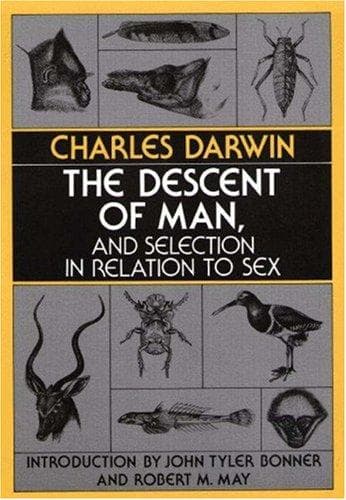
The Descent of Man, and Selection in Relation to SexDarwin, Charles
History
The Descent of Man, and Selection in Relation to Sex
Darwin, Charles
Evolution (Biology); Human beings -- Origin; Sex differences; Sexual dimorphism (Animals); Sexual selection in animals
Not withstanding many sources of doubt, man can generally and readily
distinguish between the higher and lower moral rules. The higher are
founded on the social instincts, and relate to the welfare of others.
They are supported by the approbation of our fellow-men and by reason.
The lower rules, though some of them when implying self-sacrifice
hardly deserve to be called lower, relate chiefly to self, and arise
from public opinion, matured by experience and cultivation; for they
are not practised by rude tribes.
As man advances in civilisation, and small tribes are united into
larger communities, the simplest reason would tell each individual that
he ought to extend his social instincts and sympathies to all the
members of the same nation, though personally unknown to him. This
point being once reached, there is only an artificial barrier to
prevent his sympathies extending to the men of all nations and races.
If, indeed, such men are separated from him by great differences in
appearance or habits, experience unfortunately shews us how long it is,
before we look at them as our fellow-creatures. Sympathy beyond the
confines of man, that is, humanity to the lower animals, seems to be
one of the latest moral acquisitions. It is apparently unfelt by
savages, except towards their pets. How little the old Romans knew of
it is shewn by their abhorrent gladiatorial exhibitions. The very idea
of humanity, as far as I could observe, was new to most of the Gauchos
of the Pampas. This virtue, one of the noblest with which man is
endowed, seems to arise incidentally from our sympathies becoming more
tender and more widely diffused, until they are extended to all
sentient beings. As soon as this virtue is honoured and practised by
some few men, it spreads through instruction and example to the young,
and eventually becomes incorporated in public opinion.
The highest possible stage in moral culture is when we recognise that
we ought to control our thoughts, and “not even in inmost thought to
think again the sins that made the past so pleasant to us.” (44.
Tennyson, Idylls of the King, p. 244.) Whatever makes any bad action
familiar to the mind, renders its performance by so much the easier. As
Marcus Aurelius long ago said, “Such as are thy habitual thoughts, such
also will be the character of thy mind; for the soul is dyed by the
thoughts.” (45. ‘The Thoughts of the Emperor M. Aurelius Antoninus,’
English translation, 2nd edit., 1869. p. 112. Marcus Aurelius was born
A.D. 121.)
Public-domain text, read in full here on John Shaqi.
Reviews
Reviews
No reviews yet
Be the first to share your thoughts on this work.
Elsewhere in the archive
Join the Discussion
Join the discussion
Sign in to leave a comment or review.
Sign InorCreate an account