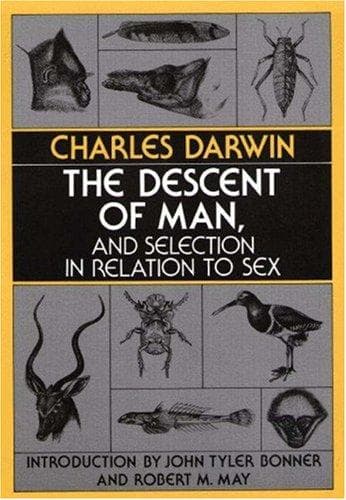
The Descent of Man, and Selection in Relation to SexDarwin, Charles
History
The Descent of Man, and Selection in Relation to Sex
Darwin, Charles
Evolution (Biology); Human beings -- Origin; Sex differences; Sexual dimorphism (Animals); Sexual selection in animals
Some naturalists, from being deeply impressed with the mental and
spiritual powers of man, have divided the whole organic world into
three kingdoms, the Human, the Animal, and the Vegetable, thus giving
to man a separate kingdom. (1. Isidore Geoffroy St.-Hilaire gives a
detailed account of the position assigned to man by various naturalists
in their classifications: ‘Hist. Nat. Gen.’ tom. ii. 1859, pp.
170-189.) Spiritual powers cannot be compared or classed by the
naturalist: but he may endeavour to shew, as I have done, that the
mental faculties of man and the lower animals do not differ in kind,
although immensely in degree. A difference in degree, however great,
does not justify us in placing man in a distinct kingdom, as will
perhaps be best illustrated by comparing the mental powers of two
insects, namely, a coccus or scale-insect and an ant, which undoubtedly
belong to the same class. The difference is here greater than, though
of a somewhat different kind from, that between man and the highest
mammal. The female coccus, whilst young, attaches itself by its
proboscis to a plant; sucks the sap, but never moves again; is
fertilised and lays eggs; and this is its whole history. On the other
hand, to describe the habits and mental powers of worker-ants, would
require, as Pierre Huber has shewn, a large volume; I may, however,
briefly specify a few points. Ants certainly communicate information to
each other, and several unite for the same work, or for games of play.
They recognise their fellow-ants after months of absence, and feel
sympathy for each other. They build great edifices, keep them clean,
close the doors in the evening, and post sentries. They make roads as
well as tunnels under rivers, and temporary bridges over them, by
clinging together. They collect food for the community, and when an
object, too large for entrance, is brought to the nest, they enlarge
the door, and afterwards build it up again. They store up seeds, of
which they prevent the germination, and which, if damp, are brought up
to the surface to dry. They keep aphides and other insects as
milch-cows. They go out to battle in regular bands, and freely
sacrifice their lives for the common weal. They emigrate according to a
preconcerted plan. They capture slaves. They move the eggs of their
aphides, as well as their own eggs and cocoons, into warm parts of the
nest, in order that they may be quickly hatched; and endless similar
facts could be given. (2. Some of the most interesting facts ever
published on the habits of ants are given by Mr. Belt, in his
‘Naturalist in Nicaragua,’ 1874. See also Mr. Moggridge’s admirable
work, ‘Harvesting Ants,’ etc., 1873, also ‘L’Instinct chez les
Insectes,’ by M. George Pouchet, ‘Revue des Deux Mondes,’ Feb. 1870, p.
682.) On the whole, the difference in mental power between an ant and a
coccus is immense; yet no one has ever dreamed of placing these insects
in distinct classes, much less in distinct kingdoms. No doubt the
Public-domain text, read in full here on John Shaqi.
Reviews
Reviews
No reviews yet
Be the first to share your thoughts on this work.
Elsewhere in the archive
Join the Discussion
Join the discussion
Sign in to leave a comment or review.
Sign InorCreate an account