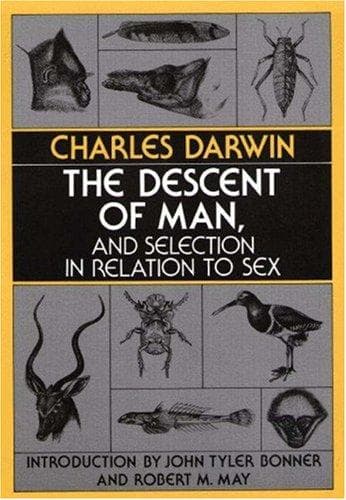
The Descent of Man, and Selection in Relation to SexDarwin, Charles
History
The Descent of Man, and Selection in Relation to Sex
Darwin, Charles
Evolution (Biology); Human beings -- Origin; Sex differences; Sexual dimorphism (Animals); Sexual selection in animals
The most ancient progenitors in the kingdom of the Vertebrata, at which
we are able to obtain an obscure glance, apparently consisted of a
group of marine animals (32. The inhabitants of the seashore must be
greatly affected by the tides; animals living either about the MEAN
high-water mark, or about the MEAN low-water mark, pass through a
complete cycle of tidal changes in a fortnight. Consequently, their
food supply will undergo marked changes week by week. The vital
functions of such animals, living under these conditions for many
generations, can hardly fail to run their course in regular weekly
periods. Now it is a mysterious fact that in the higher and now
terrestrial Vertebrata, as well as in other classes, many normal and
abnormal processes have one or more whole weeks as their periods; this
would be rendered intelligible if the Vertebrata are descended from an
animal allied to the existing tidal Ascidians. Many instances of such
periodic processes might be given, as the gestation of mammals, the
duration of fevers, etc. The hatching of eggs affords also a good
example, for, according to Mr. Bartlett (‘Land and Water,’ Jan. 7,
1871), the eggs of the pigeon are hatched in two weeks; those of the
fowl in three; those of the duck in four; those of the goose in five;
and those of the ostrich in seven weeks. As far as we can judge, a
recurrent period, if approximately of the right duration for any
process or function, would not, when once gained, be liable to change;
consequently it might be thus transmitted through almost any number of
generations. But if the function changed, the period would have to
change, and would be apt to change almost abruptly by a whole week.
This conclusion, if sound, is highly remarkable; for the period of
gestation in each mammal, and the hatching of each bird’s eggs, and
many other vital processes, thus betray to us the primordial birthplace
of these animals.), resembling the larvae of existing Ascidians. These
animals probably gave rise to a group of fishes, as lowly organised as
the lancelet; and from these the Ganoids, and other fishes like the
Lepidosiren, must have been developed. From such fish a very small
advance would carry us on to the Amphibians. We have seen that birds
and reptiles were once intimately connected together; and the
Monotremata now connect mammals with reptiles in a slight degree. But
no one can at present say by what line of descent the three higher and
related classes, namely, mammals, birds, and reptiles, were derived
from the two lower vertebrate classes, namely, amphibians and fishes.
In the class of mammals the steps are not difficult to conceive which
led from the ancient Monotremata to the ancient Marsupials; and from
these to the early progenitors of the placental mammals. We may thus
ascend to the Lemuridae; and the interval is not very wide from these
to the Simiadae. The Simiadae then branched off into two great stems,
Public-domain text, read in full here on John Shaqi.
Reviews
Reviews
No reviews yet
Be the first to share your thoughts on this work.
Elsewhere in the archive
Join the Discussion
Join the discussion
Sign in to leave a comment or review.
Sign InorCreate an account