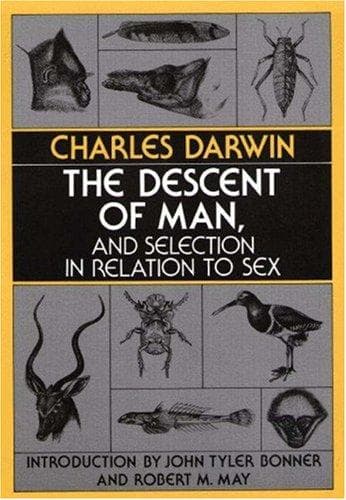
The Descent of Man, and Selection in Relation to SexDarwin, Charles
History
The Descent of Man, and Selection in Relation to Sex
Darwin, Charles
Evolution (Biology); Human beings -- Origin; Sex differences; Sexual dimorphism (Animals); Sexual selection in animals
The question whether mankind consists of one or several species has of
late years been much discussed by anthropologists, who are divided into
the two schools of monogenists and polygenists. Those who do not admit
the principle of evolution, must look at species as separate creations,
or in some manner as distinct entities; and they must decide what forms
of man they will consider as species by the analogy of the method
commonly pursued in ranking other organic beings as species. But it is
a hopeless endeavour to decide this point, until some definition of the
term “species” is generally accepted; and the definition must not
include an indeterminate element such as an act of creation. We might
as well attempt without any definition to decide whether a certain
number of houses should be called a village, town, or city. We have a
practical illustration of the difficulty in the never-ending doubts
whether many closely-allied mammals, birds, insects, and plants, which
represent each other respectively in North America and Europe, should
be ranked as species or geographical races; and the like holds true of
the productions of many islands situated at some little distance from
the nearest continent.
Those naturalists, on the other hand, who admit the principle of
evolution, and this is now admitted by the majority of rising men, will
feel no doubt that all the races of man are descended from a single
primitive stock; whether or not they may think fit to designate the
races as distinct species, for the sake of expressing their amount of
difference. (21. See Prof. Huxley to this effect in the ‘Fortnightly
Review,’ 1865, p. 275.) With our domestic animals the question whether
the various races have arisen from one or more species is somewhat
different. Although it may be admitted that all the races, as well as
all the natural species within the same genus, have sprung from the
same primitive stock, yet it is a fit subject for discussion, whether
all the domestic races of the dog, for instance, have acquired their
present amount of difference since some one species was first
domesticated by man; or whether they owe some of their characters to
inheritance from distinct species, which had already been
differentiated in a state of nature. With man no such question can
arise, for he cannot be said to have been domesticated at any
particular period.
During an early stage in the divergence of the races of man from a
common stock, the differences between the races and their number must
have been small; consequently as far as their distinguishing characters
are concerned, they then had less claim to rank as distinct species
than the existing so-called races. Nevertheless, so arbitrary is the
term of species, that such early races would perhaps have been ranked
by some naturalists as distinct species, if their differences, although
extremely slight, had been more constant than they are at present, and
had not graduated into each other.
Public-domain text, read in full here on John Shaqi.
Reviews
Reviews
No reviews yet
Be the first to share your thoughts on this work.
Elsewhere in the archive
Join the Discussion
Join the discussion
Sign in to leave a comment or review.
Sign InorCreate an account