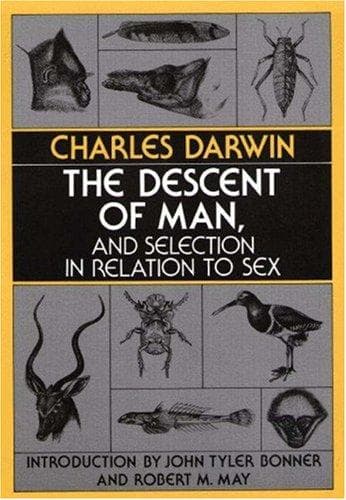
The Descent of Man, and Selection in Relation to SexDarwin, Charles
History
The Descent of Man, and Selection in Relation to Sex
Darwin, Charles
Evolution (Biology); Human beings -- Origin; Sex differences; Sexual dimorphism (Animals); Sexual selection in animals
With animals which have their sexes separated, the males necessarily
differ from the females in their organs of reproduction; and these are
the primary sexual characters. But the sexes often differ in what
Hunter has called secondary sexual characters, which are not directly
connected with the act of reproduction; for instance, the male
possesses certain organs of sense or locomotion, of which the female is
quite destitute, or has them more highly-developed, in order that he
may readily find or reach her; or again the male has special organs of
prehension for holding her securely. These latter organs, of infinitely
diversified kinds, graduate into those which are commonly ranked as
primary, and in some cases can hardly be distinguished from them; we
see instances of this in the complex appendages at the apex of the
abdomen in male insects. Unless indeed we confine the term “primary” to
the reproductive glands, it is scarcely possible to decide which ought
to be called primary and which secondary.
The female often differs from the male in having organs for the
nourishment or protection of her young, such as the mammary glands of
mammals, and the abdominal sacks of the marsupials. In some few cases
also the male possesses similar organs, which are wanting in the
female, such as the receptacles for the ova in certain male fishes, and
those temporarily developed in certain male frogs. The females of most
bees are provided with a special apparatus for collecting and carrying
pollen, and their ovipositor is modified into a sting for the defence
of the larvae and the community. Many similar cases could be given, but
they do not here concern us. There are, however, other sexual
differences quite unconnected with the primary reproductive organs, and
it is with these that we are more especially concerned—such as the
greater size, strength, and pugnacity of the male, his weapons of
offence or means of defence against rivals, his gaudy colouring and
various ornaments, his power of song, and other such characters.
Public-domain text, read in full here on John Shaqi.
Reviews
Reviews
No reviews yet
Be the first to share your thoughts on this work.
Elsewhere in the archive
Join the Discussion
Join the discussion
Sign in to leave a comment or review.
Sign InorCreate an account