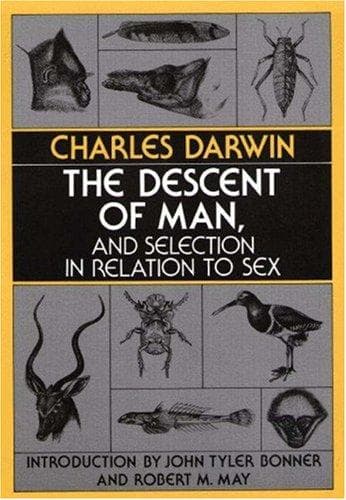
The Descent of Man, and Selection in Relation to SexDarwin, Charles
History
The Descent of Man, and Selection in Relation to Sex
Darwin, Charles
Evolution (Biology); Human beings -- Origin; Sex differences; Sexual dimorphism (Animals); Sexual selection in animals
America is polygamous, but, except in his greater
size and in the proportions of his body, differs but little from the
mare. The wild boar presents well-marked sexual characters, in his
great tusks and some other points. In Europe and in India he leads a
solitary life, except during the breeding-season; but as is believed by
Sir W. Elliot, who has had many opportunities in India of observing
this animal, he consorts at this season with several females. Whether
this holds good in Europe is doubtful, but it is supported by some
evidence. The adult male Indian elephant, like the boar, passes much of
his time in solitude; but as Dr. Campbell states, when with others, “It
is rare to find more than one male with a whole herd of females”; the
larger males expelling or killing the smaller and weaker ones. The male
differs from the female in his immense tusks, greater size, strength,
and endurance; so great is the difference in these respects that the
males when caught are valued at one-fifth more than the females. (12.
Dr. Campbell, in ‘Proc. Zoolog. Soc.’ 1869, p. 138. See also an
interesting paper by Lieut. Johnstone, in ‘Proceedings, Asiatic Society
of Bengal,’ May 1868.) The sexes of other pachydermatous animals differ
very little or not at all, and, as far as known, they are not
polygamists. Nor have I heard of any species in the Orders of
Cheiroptera, Edentata, Insectivora and Rodents being polygamous,
excepting that amongst the Rodents, the common rat, according to some
rat-catchers, lives with several females. Nevertheless the two sexes of
some sloths (Edentata) differ in the character and colour of certain
patches of hair on their shoulders. (13. Dr. Gray, in ‘Annals and
Magazine of Natural History,’ 1871, p. 302.) And many kinds of bats
(Cheiroptera) present well-marked sexual differences, chiefly in the
males possessing odoriferous glands and pouches, and by their being of
a lighter colour. (14. See Dr. Dobson’s excellent paper in ‘Proceedings
of the Zoological Society,’ 1873, p. 241.) In the great order of
Rodents, as far as I can learn, the sexes rarely differ, and when they
do so, it is but slightly in the tint of the fur.
Public-domain text, read in full here on John Shaqi.
Reviews
Reviews
No reviews yet
Be the first to share your thoughts on this work.
Elsewhere in the archive
Join the Discussion
Join the discussion
Sign in to leave a comment or review.
Sign InorCreate an account