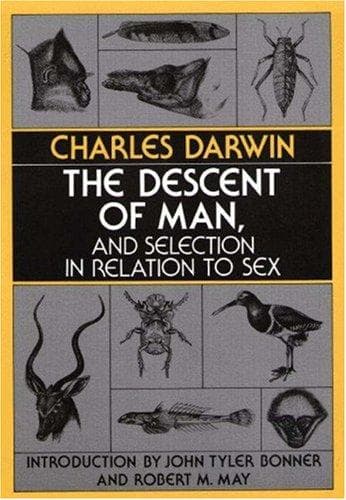
The Descent of Man, and Selection in Relation to SexDarwin, Charles
History
The Descent of Man, and Selection in Relation to Sex
Darwin, Charles
Evolution (Biology); Human beings -- Origin; Sex differences; Sexual dimorphism (Animals); Sexual selection in animals
As I hear from Sir Andrew Smith, the lion in South Africa sometimes
lives with a single female, but generally with more, and, in one case,
was found with as many as five females; so that he is polygamous. As
far as I can discover, he is the only polygamist amongst all the
terrestrial Carnivora, and he alone presents well-marked sexual
characters. If, however, we turn to the marine Carnivora, as we shall
hereafter see, the case is widely different; for many species of seals
offer extraordinary sexual differences, and they are eminently
polygamous. Thus, according to Peron, the male sea-elephant of the
Southern Ocean always possesses several females, and the sea-lion of
Forster is said to be surrounded by from twenty to thirty females. In
the North, the male sea-bear of Steller is accompanied by even a
greater number of females. It is an interesting fact, as Dr. Gill
remarks (15. ‘The Eared Seals,’ American Naturalist, vol. iv. Jan.
1871.), that in the monogamous species, “or those living in small
communities, there is little difference in size between the males and
females; in the social species, or rather those of which the males have
harems, the males are vastly larger than the females.”
Amongst birds, many species, the sexes of which differ greatly from
each other, are certainly monogamous. In Great Britain we see
well-marked sexual differences, for instance, in the wild-duck which
pairs with a single female, the common blackbird, and the bullfinch
which is said to pair for life. I am informed by Mr. Wallace that the
like is true of the Chatterers or Cotingidae of South America, and of
many other birds. In several groups I have not been able to discover
whether the species are polygamous or monogamous. Lesson says that
birds of paradise, so remarkable for their sexual differences, are
polygamous, but Mr. Wallace doubts whether he had sufficient evidence.
Mr. Salvin tells me he has been led to believe that humming-birds are
polygamous. The male widow-bird, remarkable for his caudal plumes,
certainly seems to be a polygamist. (16. ‘The Ibis,’ vol. iii. 1861, p.
133, on the Progne Widow-bird. See also on the Vidua axillaris, ibid.
vol. ii. 1860, p. 211. On the polygamy of the Capercailzie and Great
Bustard, see L. Lloyd, ‘Game Birds of Sweden,’ 1867, pp. 19, and 182.
Montagu and Selby speak of the Black Grouse as polygamous and of the
Red Grouse as monogamous.) I have been assured by Mr. Jenner Weir and
by others, that it is somewhat common for three starlings to frequent
the same nest; but whether this is a case of polygamy or polyandry has
not been ascertained.
Public-domain text, read in full here on John Shaqi.
Reviews
Reviews
No reviews yet
Be the first to share your thoughts on this work.
Elsewhere in the archive
Join the Discussion
Join the discussion
Sign in to leave a comment or review.
Sign InorCreate an account