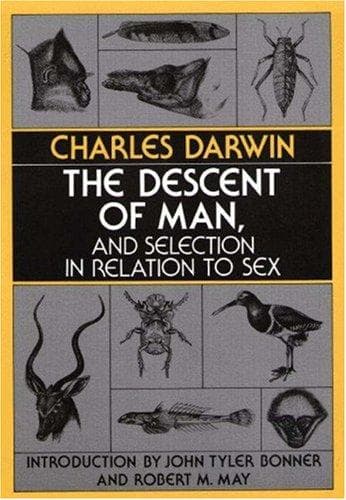
The Descent of Man, and Selection in Relation to SexDarwin, Charles
History
The Descent of Man, and Selection in Relation to Sex
Darwin, Charles
Evolution (Biology); Human beings -- Origin; Sex differences; Sexual dimorphism (Animals); Sexual selection in animals
The cause of the greater general variability in the male sex, than in
the female is unknown, except in so far as secondary sexual characters
are extraordinarily variable, and are usually confined to the males;
and, as we shall presently see, this fact is, to a certain extent,
intelligible. Through the action of sexual and natural selection male
animals have been rendered in very many instances widely different from
their females; but independently of selection the two sexes, from
differing constitutionally, tend to vary in a somewhat different
manner. The female has to expend much organic matter in the formation
of her ova, whereas the male expends much force in fierce contests with
his rivals, in wandering about in search of the female, in exerting his
voice, pouring out odoriferous secretions, etc.: and this expenditure
is generally concentrated within a short period. The great vigour of
the male during the season of love seems often to intensify his
colours, independently of any marked difference from the female. (29.
Prof. Mantegazza is inclined to believe (‘Lettera a Carlo Darwin,’
‘Archivio per l’Anthropologia,’ 1871, p. 306) that the bright colours,
common in so many male animals, are due to the presence and retention
by them of the spermatic fluid; but this can hardly be the case; for
many male birds, for instance young pheasants, become brightly coloured
in the autumn of their first year.) In mankind, and even as low down in
the organic scale as in the Lepidoptera, the temperature of the body is
higher in the male than in the female, accompanied in the case of man
by a slower pulse. (30. For mankind, see Dr. J. Stockton Hough, whose
conclusions are given in the ‘Popular Science Review,’ 1874, p. 97. See
Girard’s observations on the Lepidoptera, as given in the ‘Zoological
Record,’ 1869, p. 347.) On the whole the expenditure of matter and
force by the two sexes is probably nearly equal, though effected in
very different ways and at different rates.
Public-domain text, read in full here on John Shaqi.
Reviews
Reviews
No reviews yet
Be the first to share your thoughts on this work.
Elsewhere in the archive
Join the Discussion
Join the discussion
Sign in to leave a comment or review.
Sign InorCreate an account