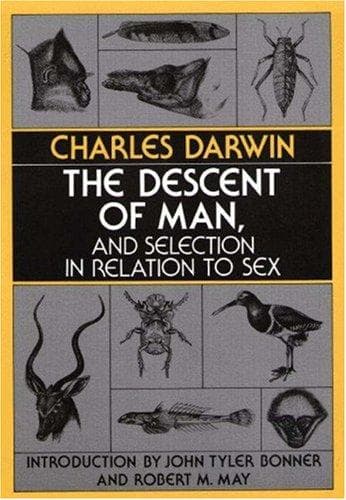
The Descent of Man, and Selection in Relation to SexDarwin, Charles
History
The Descent of Man, and Selection in Relation to Sex
Darwin, Charles
Evolution (Biology); Human beings -- Origin; Sex differences; Sexual dimorphism (Animals); Sexual selection in animals
An excellent case for investigation is afforded by the Deer family. In
all the species, but one, the horns are developed only in the males,
though certainly transmitted through the females, and capable of
abnormal development in them. In the reindeer, on the other hand, the
female is provided with horns; so that in this species, the horns
ought, according to our rule, to appear early in life, long before the
two sexes are mature and have come to differ much in constitution. In
all the other species the horns ought to appear later in life, which
would lead to their development in that sex alone, in which they first
appeared in the progenitor of the whole Family. Now in seven species,
belonging to distinct sections of the family and inhabiting different
regions, in which the stags alone bear horns, I find that the horns
first appear at periods, varying from nine months after birth in the
roebuck, to ten, twelve or even more months in the stags of the six
other and larger species. (39. I am much obliged to Mr. Cupples for
having made enquiries for me in regard to the Roebuck and Red Deer of
Scotland from Mr. Robertson, the experienced head-forester to the
Marquis of Breadalbane. In regard to Fallow-deer, I have to thank Mr.
Eyton and others for information. For the Cervus alces of N. America,
see ‘Land and Water,’ 1868, pp. 221 and 254; and for the C. Virginianus
and strongyloceros of the same continent, see J.D. Caton, in ‘Ottawa
Acad. of Nat. Sc.’ 1868, p. 13. For Cervus Eldi of Pegu, see Lieut.
Beaven, ‘Proccedings of the Zoological Society,’ 1867, p. 762.) But
with the reindeer the case is widely different; for, as I hear from
Prof. Nilsson, who kindly made special enquiries for me in Lapland, the
horns appear in the young animals within four or five weeks after
birth, and at the same time in both sexes. So that here we have a
structure, developed at a most unusually early age in one species of
the family, and likewise common to both sexes in this one species
alone.
Public-domain text, read in full here on John Shaqi.
Reviews
Reviews
No reviews yet
Be the first to share your thoughts on this work.
Elsewhere in the archive
Join the Discussion
Join the discussion
Sign in to leave a comment or review.
Sign InorCreate an account