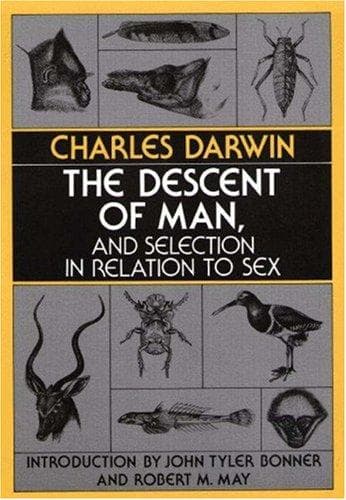
The Descent of Man, and Selection in Relation to SexDarwin, Charles
History
The Descent of Man, and Selection in Relation to Sex
Darwin, Charles
Evolution (Biology); Human beings -- Origin; Sex differences; Sexual dimorphism (Animals); Sexual selection in animals
chickens are hatched, and the crest itself soon begins to grow, though
at first feebly (47. For full particulars and references on all these
points respecting the several breeds of the Fowl, see ‘Variation of
Animals and Plants under Domestication,’ vol. i. pp. 250, 256. In
regard to the higher animals, the sexual differences which have arisen
under domestication are described in the same work under the head of
each species.); and in this breed the adults of both sexes are
characterised by a great bony protuberance and an immense crest.
Finally, from what we have now seen of the relation which exists in
many natural species and domesticated races, between the period of the
development of their characters and the manner of their
transmission—for example, the striking fact of the early growth of the
horns in the reindeer, in which both sexes bear horns, in comparison
with their much later growth in the other species in which the male
alone bears horns—we may conclude that one, though not the sole cause
of characters being exclusively inherited by one sex, is their
development at a late age. And secondly, that one, though apparently a
less efficient cause of characters being inherited by both sexes, is
their development at an early age, whilst the sexes differ but little
in constitution. It appears, however, that some difference must exist
between the sexes even during a very early embryonic period, for
characters developed at this age not rarely become attached to one sex.
A SUMMARY AND CONCLUDING REMARKS.
From the foregoing discussion on the various laws of inheritance, we
learn that the characters of the parents often, or even generally, tend
to become developed in the offspring of the same sex, at the same age,
and periodically at the same season of the year, in which they first
appeared in the parents. But these rules, owing to unknown causes, are
far from being fixed. Hence during the modification of a species, the
successive changes may readily be transmitted in different ways; some
to one sex, and some to both; some to the offspring at one age, and
some to the offspring at all ages. Not only are the laws of inheritance
extremely complex, but so are the causes which induce and govern
variability. The variations thus induced are preserved and accumulated
by sexual selection, which is in itself an extremely complex affair,
depending, as it does, on the ardour in love, the courage, and the
rivalry of the males, as well as on the powers of perception, the
taste, and will of the female. Sexual selection will also be largely
dominated by natural selection tending towards the general welfare of
the species. Hence the manner in which the individuals of either or
both sexes have been affected through sexual selection cannot fail to
be complex in the highest degree.
Public-domain text, read in full here on John Shaqi.
Reviews
Reviews
No reviews yet
Be the first to share your thoughts on this work.
Elsewhere in the archive
Join the Discussion
Join the discussion
Sign in to leave a comment or review.
Sign InorCreate an account