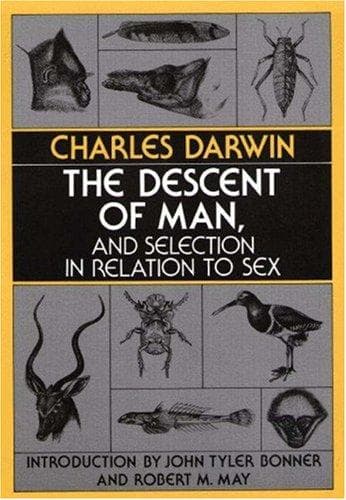
The Descent of Man, and Selection in Relation to Sex — John Shaqi
The Descent of Man, and Selection in Relation to SexDarwin, Charles
History
The Descent of Man, and Selection in Relation to Sex
Darwin, Charles
Evolution (Biology); Human beings -- Origin; Sex differences; Sexual dimorphism (Animals); Sexual selection in animals
CHAPTER II.
ON THE MANNER OF DEVELOPMENT OF MAN FROM SOME LOWER FORM.
Variability of body and mind in man—Inheritance—Causes of
variability—Laws of variation the same in man as in the lower
animals—Direct action of the conditions of life—Effects of the
increased use and disuse of parts—Arrested
development—Reversion—Correlated variation—Rate of increase—Checks to
increase—Natural selection—Man the most dominant animal in the
world—Importance of his corporeal structure—The causes which have led
to his becoming erect—Consequent changes of structure—Decrease in size
of the canine teeth—Increased size and altered shape of the
skull—Nakedness —Absence of a tail—Defenceless condition of man.
CHAPTER III.
COMPARISON OF THE MENTAL POWERS OF MAN AND THE LOWER ANIMALS.
The difference in mental power between the highest ape and the lowest
savage, immense—Certain instincts in common—The
emotions—Curiosity—Imitation—Attention—Memory—
Imagination—Reason—Progressive improvement —Tools and weapons used by
animals—Abstraction, Self-consciousness—Language—Sense of beauty—Belief
in God, spiritual agencies, superstitions.
CHAPTER IV.
COMPARISON OF THE MENTAL POWERS OF MAN AND THE LOWER ANIMALS,
continued.
The moral sense—Fundamental proposition—The qualities of social
animals—Origin of sociability—Struggle between opposed instincts—Man a
social animal—The more enduring social instincts conquer other less
persistent instincts—The social virtues alone regarded by savages—The
self-regarding virtues acquired at a later stage of development—The
importance of the judgment of the members of the same community on
conduct—Transmission of moral tendencies—Summary.
CHAPTER V.
ON THE DEVELOPMENT OF THE INTELLECTUAL AND MORAL FACULTIES DURING
PRIMEVAL AND CIVILISED TIMES.
Advancement of the intellectual powers through natural
selection—Importance of imitation—Social and moral faculties—Their
development within the limits of the same tribe—Natural selection as
affecting civilised nations—Evidence that civilised nations were once
barbarous.
CHAPTER VI.
ON THE AFFINITIES AND GENEALOGY OF MAN.
Position of man in the animal series—The natural system
genealogical—Adaptive characters of slight value—Various small points
of resemblance between man and the Quadrumana—Rank of man in the
natural system—Birthplace and antiquity of man—Absence of fossil
connecting-links—Lower stages in the genealogy of man, as inferred
firstly from his affinities and secondly from his structure—Early
androgynous condition of the Vertebrata —Conclusion.
Public-domain text, read in full here on John Shaqi.
Reviews
Reviews
No reviews yet
Be the first to share your thoughts on this work.
Join the Discussion
Join the discussion
Sign in to leave a comment or review.
Sign InorCreate an account