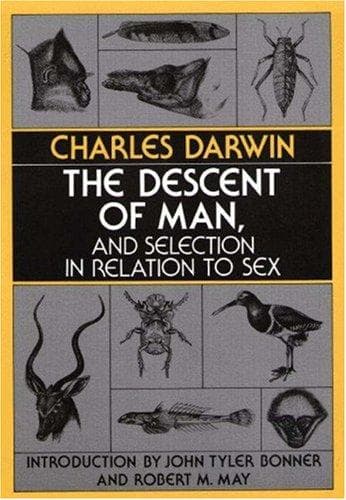
The Descent of Man, and Selection in Relation to Sex — John Shaqi
The Descent of Man, and Selection in Relation to SexDarwin, Charles
History
The Descent of Man, and Selection in Relation to Sex
Darwin, Charles
Evolution (Biology); Human beings -- Origin; Sex differences; Sexual dimorphism (Animals); Sexual selection in animals
CHAPTER VII.
ON THE RACES OF MAN.
The nature and value of specific characters—Application to the races of
man—Arguments in favour of, and opposed to, ranking the so-called races
of man as distinct species—Sub-species—Monogenists and
polygenists—Convergence of character—Numerous points of resemblance in
body and mind between the most distinct races of man—The state of man
when he first spread over the earth—Each race not descended from a
single pair—The extinction of races—The formation of races—The effects
of crossing—Slight influence of the direct action of the conditions of
life—Slight or no influence of natural selection—Sexual selection.
PART II. SEXUAL SELECTION.
CHAPTER VIII.
PRINCIPLES OF SEXUAL SELECTION.
Secondary sexual characters—Sexual selection—Manner of action—Excess of
males—Polygamy—The male alone generally modified through sexual
selection—Eagerness of the male—Variability of the male—Choice exerted
by the female—Sexual compared with natural selection—Inheritance at
corresponding periods of life, at corresponding seasons of the year,
and as limited by sex—Relations between the several forms of
inheritance—Causes why one sex and the young are not modified through
sexual selection—Supplement on the proportional numbers of the two
sexes throughout the animal kingdom—The proportion of the sexes in
relation to natural selection.
CHAPTER IX.
SECONDARY SEXUAL CHARACTERS IN THE LOWER CLASSES OF THE ANIMAL KINGDOM.
These characters are absent in the lowest classes—Brilliant
colours—Mollusca—Annelids—Crustacea, secondary sexual characters
strongly developed; dimorphism; colour; characters not acquired before
maturity—Spiders, sexual colours of; stridulation by the
males—Myriapoda.
CHAPTER X.
SECONDARY SEXUAL CHARACTERS OF INSECTS.
Diversified structures possessed by the males for seizing the
females—Differences between the sexes, of which the meaning is not
understood—Difference in size between the
sexes—Thysanura—Diptera—Hemiptera—Homoptera, musical powers possessed
by the males alone—Orthoptera, musical instruments of the males, much
diversified in structure; pugnacity; colours—Neuroptera, sexual
differences in colour—Hymenoptera, pugnacity and odours—Coleoptera,
colours; furnished with great horns, apparently as an ornament;
battles; stridulating organs generally common to both sexes.
CHAPTER XI.
INSECTS, continued. ORDER LEPIDOPTERA. (BUTTERFLIES AND MOTHS.)
Courtship of Butterflies—Battles—Ticking noise—Colours common to both
sexes, or more brilliant in the males—Examples—Not due to the direct
action of the conditions of life—Colours adapted for protection—Colours
of moths—Display—Perceptive powers of the
Lepidoptera—Variability—Causes of the difference in colour between the
males and females—Mimicry, female butterflies more brilliantly coloured
than the males—Bright colours of caterpillars—Summary and concluding
remarks on the secondary sexual character of insects—Birds and insects
compared.
Public-domain text, read in full here on John Shaqi.
Reviews
Reviews
No reviews yet
Be the first to share your thoughts on this work.
Join the Discussion
Join the discussion
Sign in to leave a comment or review.
Sign InorCreate an account