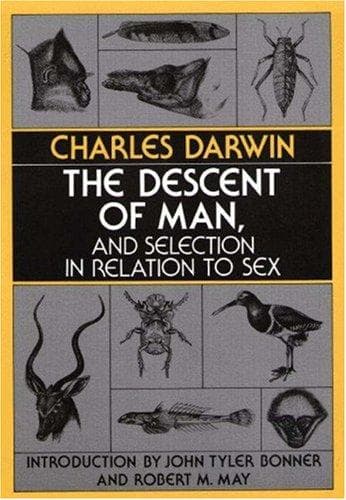
The Descent of Man, and Selection in Relation to SexDarwin, Charles
History
The Descent of Man, and Selection in Relation to Sex
Darwin, Charles
Evolution (Biology); Human beings -- Origin; Sex differences; Sexual dimorphism (Animals); Sexual selection in animals
CHAPTER XII.
SECONDARY SEXUAL CHARACTERS OF FISHES, AMPHIBIANS, AND REPTILES.
Fishes: Courtship and battles of the males—Larger size of the
females—Males, bright colours and ornamental appendages; other strange
characters—Colours and appendages acquired by the males during the
breeding-season alone—Fishes with both sexes brilliantly
coloured—Protective colours—The less conspicuous colours of the female
cannot be accounted for on the principle of protection—Male fishes
building nests, and taking charge of the ova and young. AMPHIBIANS:
Differences in structure and colour between the sexes—Vocal organs.
REPTILES: Chelonians—Crocodiles—Snakes, colours in some cases
protective—Lizards, battles of—Ornamental appendages—Strange
differences in structure between the sexes—Colours—Sexual differences
almost as great as with birds.
CHAPTER XIII.
SECONDARY SEXUAL CHARACTERS OF BIRDS.
Sexual differences—Law of battle—Special weapons—Vocal
organs—Instrumental music—Love-antics and dances—Decorations, permanent
and seasonal—Double and single annual moults—Display of ornaments by
the males.
CHAPTER XIV.
BIRDS—continued.
Choice exerted by the female—Length of courtship—Unpaired birds—Mental
qualities and taste for the beautiful—Preference or antipathy shewn by
the female for particular males—Variability of birds—Variations
sometimes abrupt—Laws of variation—Formation of ocelli—Gradations of
character—Case of Peacock, Argus pheasant, and Urosticte.
CHAPTER XV.
BIRDS—continued.
Discussion as to why the males alone of some species, and both sexes of
others are brightly coloured—On sexually-limited inheritance, as
applied to various structures and to brightly-coloured
plumage—Nidification in relation to colour—Loss of nuptial plumage
during the winter.
CHAPTER XVI.
BIRDS—concluded.
The immature plumage in relation to the character of the plumage in
both sexes when adult—Six classes of cases—Sexual differences between
the males of closely-allied or representative species—The female
assuming the characters of the male—Plumage of the young in relation to
the summer and winter plumage of the adults—On the increase of beauty
in the birds of the world—Protective colouring—Conspicuously coloured
birds—Novelty appreciated—Summary of the four chapters on birds.
CHAPTER XVII.
SECONDARY SEXUAL CHARACTERS OF MAMMALS.
The law of battle—Special weapons, confined to the males—Cause of
absence of weapons in the female—Weapons common to both sexes, yet
primarily acquired by the male—Other uses of such weapons—Their high
importance—Greater size of the male—Means of defence—On the preference
shewn by either sex in the pairing of quadrupeds.
Public-domain text, read in full here on John Shaqi.
Reviews
Reviews
No reviews yet
Be the first to share your thoughts on this work.
Join the Discussion
Join the discussion
Sign in to leave a comment or review.
Sign InorCreate an account