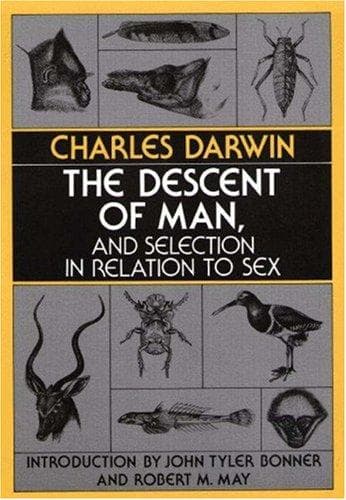
The Descent of Man, and Selection in Relation to Sex — John Shaqi
The Descent of Man, and Selection in Relation to SexDarwin, Charles
History
The Descent of Man, and Selection in Relation to Sex
Darwin, Charles
Evolution (Biology); Human beings -- Origin; Sex differences; Sexual dimorphism (Animals); Sexual selection in animals
Malthus has discussed these several checks, but he does not lay stress
enough on what is probably the most important of all, namely
infanticide, especially of female infants, and the habit of procuring
abortion. These practices now prevail in many quarters of the world;
and infanticide seems formerly to have prevailed, as Mr. M’Lennan (61.
‘Primitive Marriage,’ 1865.) has shewn, on a still more extensive
scale. These practices appear to have originated in savages recognising
the difficulty, or rather the impossibility of supporting all the
infants that are born. Licentiousness may also be added to the
foregoing checks; but this does not follow from failing means of
subsistence; though there is reason to believe that in some cases (as
in Japan) it has been intentionally encouraged as a means of keeping
down the population.
If we look back to an extremely remote epoch, before man had arrived at
the dignity of manhood, he would have been guided more by instinct and
less by reason than are the lowest savages at the present time. Our
early semi-human progenitors would not have practised infanticide or
polyandry; for the instincts of the lower animals are never so
perverted (62. A writer in the ‘Spectator’ (March 12, 1871, p. 320)
comments as follows on this passage:—“Mr. Darwin finds himself
compelled to reintroduce a new doctrine of the fall of man. He shews
that the instincts of the higher animals are far nobler than the habits
of savage races of men, and he finds himself, therefore, compelled to
re-introduce,—in a form of the substantial orthodoxy of which he
appears to be quite unconscious,—and to introduce as a scientific
hypothesis the doctrine that man’s gain of KNOWLEDGE was the cause of a
temporary but long-enduring moral deterioration as indicated by the
many foul customs, especially as to marriage, of savage tribes. What
does the Jewish tradition of the moral degeneration of man through his
snatching at a knowledge forbidden him by his highest instinct assert
beyond this?”) as to lead them regularly to destroy their own
offspring, or to be quite devoid of jealousy. There would have been no
prudential restraint from marriage, and the sexes would have freely
united at an early age. Hence the progenitors of man would have tended
to increase rapidly; but checks of some kind, either periodical or
constant, must have kept down their numbers, even more severely than
with existing savages. What the precise nature of these checks were, we
cannot say, any more than with most other animals. We know that horses
and cattle, which are not extremely prolific animals, when first turned
loose in South America, increased at an enormous rate. The elephant,
the slowest breeder of all known animals, would in a few thousand years
stock the whole world. The increase of every species of monkey must be
checked by some means; but not, as Brehm remarks, by the attacks of
beasts of prey. No one will assume that the actual power of
Public-domain text, read in full here on John Shaqi.
Reviews
Reviews
No reviews yet
Be the first to share your thoughts on this work.
Join the Discussion
Join the discussion
Sign in to leave a comment or review.
Sign InorCreate an account