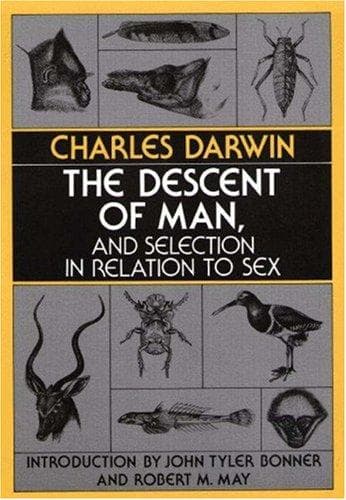
The Descent of Man, and Selection in Relation to Sex — John Shaqi
The Descent of Man, and Selection in Relation to SexDarwin, Charles
History
The Descent of Man, and Selection in Relation to Sex
Darwin, Charles
Evolution (Biology); Human beings -- Origin; Sex differences; Sexual dimorphism (Animals); Sexual selection in animals
reproduction in the wild horses and cattle of America, was at first in
any sensible degree increased; or that, as each district became fully
stocked, this same power was diminished. No doubt, in this case, and in
all others, many checks concur, and different checks under different
circumstances; periodical dearths, depending on unfavourable seasons,
being probably the most important of all. So it will have been with the
early progenitors of man.
NATURAL SELECTION.
We have now seen that man is variable in body and mind; and that the
variations are induced, either directly or indirectly, by the same
general causes, and obey the same general laws, as with the lower
animals. Man has spread widely over the face of the earth, and must
have been exposed, during his incessant migrations (63. See some good
remarks to this effect by W. Stanley Jevons, “A Deduction from Darwin’s
Theory,” ‘Nature,’ 1869, p. 231.), to the most diversified conditions.
The inhabitants of Tierra del Fuego, the Cape of Good Hope, and
Tasmania in the one hemisphere, and of the arctic regions in the other,
must have passed through many climates, and changed their habits many
times, before they reached their present homes. (64. Latham, ‘Man and
his Migrations,’ 1851, p. 135.) The early progenitors of man must also
have tended, like all other animals, to have increased beyond their
means of subsistence; they must, therefore, occasionally have been
exposed to a struggle for existence, and consequently to the rigid law
of natural selection. Beneficial variations of all kinds will thus,
either occasionally or habitually, have been preserved and injurious
ones eliminated. I do not refer to strongly-marked deviations of
structure, which occur only at long intervals of time, but to mere
individual differences. We know, for instance, that the muscles of our
hands and feet, which determine our powers of movement, are liable,
like those of the lower animals, (65. Messrs. Murie and Mivart in their
‘Anatomy of the Lemuroidea’ (‘Transact. Zoolog. Soc.’ vol. vii. 1869,
pp. 96-98) say, “some muscles are so irregular in their distribution
that they cannot be well classed in any of the above groups.” These
muscles differ even on the opposite sides of the same individual.) to
incessant variability. If then the progenitors of man inhabiting any
district, especially one undergoing some change in its conditions, were
divided into two equal bodies, the one half which included all the
individuals best adapted by their powers of movement for gaining
subsistence, or for defending themselves, would on an average survive
in greater numbers, and procreate more offspring than the other and
less well endowed half.
Public-domain text, read in full here on John Shaqi.
Reviews
Reviews
No reviews yet
Be the first to share your thoughts on this work.
Join the Discussion
Join the discussion
Sign in to leave a comment or review.
Sign InorCreate an account