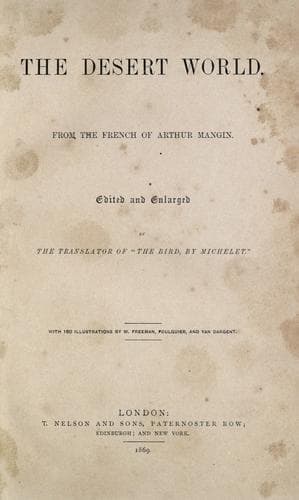
[Every attempt has been made to replicate the original book as printed.
The footnotes have been located at the end of the etext. Some
typographical errors have been corrected. A list follows the etext. No
attempt has been made to correct or normalize printed botanical names.
The footnotes have all been moved to the end of the etext. Some
illustrations have been moved from within paragraphs for ease of
reading. (etext transcriber's note)]
THE DESERT WORLD.
"For I have learned
To look on Nature, not as in the hour
Of thoughtless youth; but hearing oftentimes
The still sad music of humanity."
WORDSWORTH
THE DESERT WORLD.
FROM THE FRENCH OF ARTHUR MANGIN.
Edited and Enlarged
_BY_
_THE TRANSLATOR OF "THE BIRD, BY MICHELET."_
WITH 160 ILLUSTRATIONS BY W. FREEMAN, FOULQUIER, AND YAN DARGENT.
LONDON:
T. NELSON AND SONS, PATERNOSTER ROW;
EDINBURGH; AND NEW YORK.
1869.
Preface.
The area of our present work would be very limited if we understood the
word _Desert_ in its more rigorous signification; for we should then
have only to consider those desolate wildernesses which an inclement sky
and a sterile soil seem to exclude for ever from man's dominion.
But, by a license which usage authorizes, we are able to attribute to
this term a much more extended sense; and to call _Deserts_ not only the
sandy seas of Africa and Asia, the icy wastes of the Poles, and the
inaccessible crests of the great mountain-chains; but all the regions
where man has not planted his regular communities or permanent abodes;
where earth has never been appropriated, tilled, and subjected to
cultivation; where Nature has maintained her inviolability against the
encroachments of human industry.
Thus understood, the picture we are about to trace assumes not only vast
proportions, but an infinite variety of aspects.
Here and there, it is true, our eyes will rest on the gloomy spectacle
of rugged solitudes, where the soil churlishly refuses almost every kind
of product, where the boldest traveller cannot penetrate without a
shudder, and where the very beast of prey is rather a visitor than an
inhabitant: lugubrious regions, on whose threshold one might write the
legend written, according to Dante, on the gates of hell--
"Lasciate ogni speranza, voi ch'entrate."
(All hope abandon, ye who enter here.)
Public-domain text, read in full here on John Shaqi.
Reviews
Reviews
No reviews yet
Be the first to share your thoughts on this work.
Join the Discussion
Join the discussion
Sign in to leave a comment or review.
Sign InorCreate an account