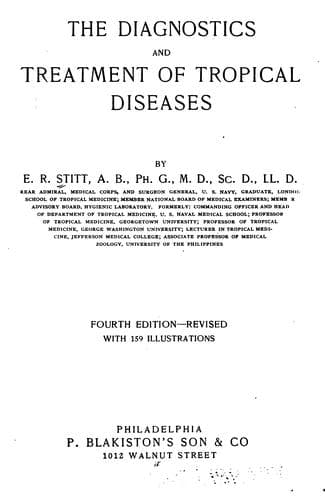
The diagnostics and treatment of tropical diseasesStitt, E. R. (Edward Rhodes)
Science
The diagnostics and treatment of tropical diseases
Stitt, E. R. (Edward Rhodes)
Tropical medicine
The culture should be kept at a temperature of about 22°C.
One should always first examine a smear of the peripheral blood for
parasites in polymorphonuclear or large mononuclear leucocytes. The
Sudan Commission found leishman bodies in the peripheral blood of
13 out of 15 cases so examined, but rarely did they find more than
one parasite-containing leucocyte to a slide.
It is well to select a time when some pyogenic infection causes a
leucocytosis.
Quite recently Wenyon and others have noted the desirability of
culturing the peripheral blood in N. N. N. medium. Diagnosis may be
made in this way, provided one wait from two to three weeks before
reporting negatively as to the presence of flagellated _Leishmania_
in the cultures. As before stated, strict asepsis and a room
temperature are requisite for flagellate development.
It has been noted that artificial pustulation might assist in
diagnosis by giving a multitude of polymorphonuclear leucocytes for
examination for phagocytized _Leishmania_.
Cochran has recently noted the advisability of excising a lymphatic
gland and making gland smears to examine for _Leishmania_. Others
have reported success with gland puncture as utilized in the gland
of trypanosomiasis.
Animal inoculation has no place in diagnosis as such a procedure is
but rarely successful. Ray has recently proposed a turbidity test
in which about 2 drops of blood are added to 20 drops of distilled
water. Instead of giving a clear solution of haemoglobin we have a
turbidity followed later by a white flocculent precipitate. It is
now thought that this turbidity is due to excess of serum globulin
in the blood of this disease and the test can be carried out with
serum instead of whole blood.
=Prognosis.=—Kala-azar is a chronic disease in the great majority
of cases although both the adult and infantile types may show cases
rapidly running to a fatal termination. Marked intestinal disturbance
makes for a bad prognosis as does also a low large mononuclear
percentage. A marked leucopenia is a bad sign particularly when
associated with such low polymorphonuclear percentages as ten to
twenty. Rogers notes that in children the polymorphonuclears several
times did not give more than 5% of the total leucocyte percentage.
The mortality is usually given as about 95% although Rogers states
that he has reduced this to 75% by large doses of quinine. The
action of antimony is that of a specific. Patients often succumb to
complicating septic conditions or pneumonia.
Prophylaxis and Treatment
Public-domain text, read in full here on John Shaqi.
Reviews
Reviews
No reviews yet
Be the first to share your thoughts on this work.
Elsewhere in the archive
Join the Discussion
Join the discussion
Sign in to leave a comment or review.
Sign InorCreate an account