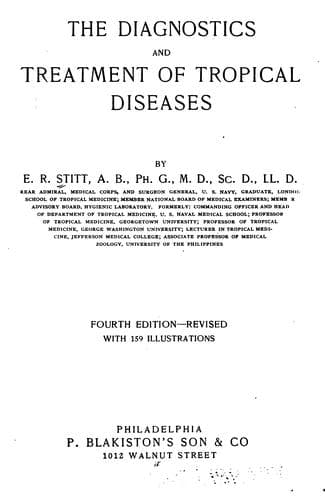
The diagnostics and treatment of tropical diseases — John Shaqi
The diagnostics and treatment of tropical diseasesStitt, E. R. (Edward Rhodes)
Science
The diagnostics and treatment of tropical diseases
Stitt, E. R. (Edward Rhodes)
Tropical medicine
Six new chapters have been added to the book, viz. Epidemic jaundice,
rat bite fever, tularaemia, tables of helminthic and arthropodan
diseases, trench fever, in Part I, and, in Part II, a chapter on the
diagnostics of tropical joint, muscle and bone lesions.
Extensive additions have been made to Chapter XLIII, “Diagnostic
problems and procedures, together with cosmopolitan diseases in the
tropics”; and in the chapter on blood examinations will be found a
presentation of our latest views as to acidosis as well as a table
giving the significance of the findings in blood chemistry.
Many new illustrations have been added and some of the older ones
replaced by others of greater teaching value.
Every effort has been made to retain the feature of a pocket manual
but it has been necessary to increase the number of pages from 524
to 610. The illustrations in the third edition numbered 119; in this
edition, 159.
In particular I have to express my indebtedness to Commanders C. S.
Butler and H. W. Smith of the Naval Medical Corps for advice and
assistance in the preparation of this edition. Dr. G. W. McCoy,
Director of the Hygienic Laboratory, has given me valued suggestions
as to changes in some of the old chapters and in the preparation of
the new chapter on Tularaemia.
Lieutenant Commander Bunker, the head of the Chemical Laboratory of
the Naval Medical School, has made the revisions of the subjects
dealing with physiological chemistry. Others, who have given me
advice and suggestions, have been Lieutenant Commander Reed and
Lieutenants Harper and Chambers of the Naval Medical School.
To Lieutenant Peterson I am indebted for assistance in the
proofreading and preparation of the index as well as in going over
the recent literature of tropical diseases.
PREFACE TO FIRST EDITION
There is no more striking evidence of advance in general medicine
than the present attitude of the physician or rather internist in the
diagnosis of the cases met with in a modern hospital ward. Instead
of first considering the evidence obtainable at the bedside and
then noting the laboratory findings as something apart and entirely
subordinate, we now find the two aids to diagnosis so correlated
that it is as difficult to note one kind of information as bedside
and other as laboratory as it formerly was to separate signs from
symptoms in the study of a case.
In tropical medicine, however, we have for many years made our
diagnosis in the laboratory, the bedside playing a subsidiary
part—the laboratory diagnosis is controlled by the bedside findings.
Public-domain text, read in full here on John Shaqi.
Reviews
Reviews
No reviews yet
Be the first to share your thoughts on this work.
Join the Discussion
Join the discussion
Sign in to leave a comment or review.
Sign InorCreate an account